





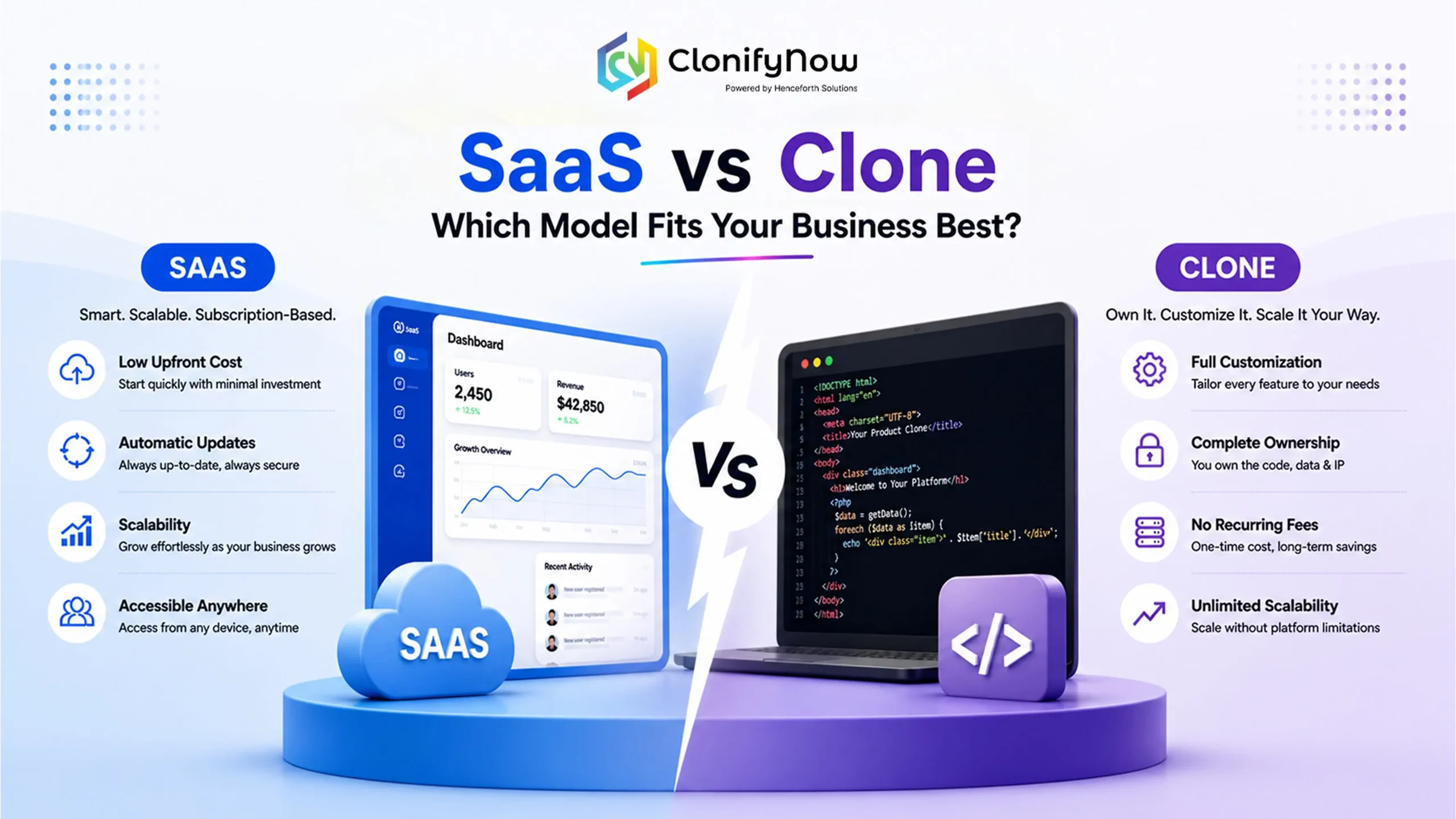
Do you want to enter into the on-demand industry, or are you looking for a platform that can help your business grow? Well, most businesses go for either one of the two options, which are SaaS and clones. But what exactly are these business models? What are SaaS vs. clone apps? In this blog, we will help you know about them. So, it does not matter whether you want to launch a taxi management app or you have any other app in mind; you will know after reading this blog, which will align with your business needs. Though both models build software solutions faster, they differ fundamentally in purpose, structure, and business outcomes. So, understanding the difference between them will help you know in which development you should invest your money.
SaaS vs Clone Apps: Understanding the Core Difference
SaaS vs. clones are two different business models. One is a subscription-based business model, while the other replicates an existing business solution. Consider Netflix as an example of a SaaS app. Users have to subscribe to get access to Netflix content. Users don’t buy the software but the subscription to use the app. A clone app, on the other hand, is built on the pre-developed framework of popular apps. So, they stand as a standalone solution, which a business can own and brand. If you still can’t understand the difference between the two, below we have explained them one by one.
What is SaaS software?
SaaS stands for Software as a Service. In this cloud computing model, the application is hosted by a service provider and made available to users on the internet. Imagine a school where nothing is permanently “owned” or installed locally. Students don’t carry physical textbooks because all learning materials are stored online and accessed whenever needed. Similarly, instead of installing software on individual computers, the school uses systems that run through a browser. Teachers and administrators don’t manage separate machines or software installations. Instead, they log into a central online dashboard (or admin console) where they can control everything, like student data, learning tools, schedules, and system settings, from one place. SaaS software is characterized by the following features:
- All the software is housed on the provider’s side and is taken care of at the provider’s expense.
- The SaaS application is continuously updated and administered by the provider.
- All costs are included in the pricing model and are charged at regular intervals as a fixed amount.
- Once implemented, the provider takes a step back, and the system runs on its own.
- Projects continue for as long as the system is in use.
Read more: Inside the Business Model? How does it work
What is Clone App Development?
Clone app development refers to the process of creating a software application that replicates the functionality, design logic, and user flow of an already successful app. For example, a DoorDash clone, Uber clone, or Instagram clone is built using similar features and architecture but is customized for a new business or market. Clone app development is widely used by startups because it uses pre-built frameworks, which reduces development cost and time. Moreover, as they are made from proven business models, they carry lower market risks.
Key advantages of clone app development include the following:
- Businesses reach the target market faster.
- Lower development costs.
- Lower risk; the business model is more predictable.
- Has simpler customization options for niche markets.
However, clone apps may lack the flexibility and scalability of SaaS platforms if not designed carefully.
Read more: What is a clone app? How does the clone app work and how it help modern businesses grow in 2026?
What is the Difference Between SaaS and Clone?
For many entrepreneurs, one of the most moving questions is, “What is the difference between SaaS and a clone?” Though both models do software delivery, they are fundamentally different in the structural sense, as well as the purpose they aim to serve.
A SaaS (Software as a Service) application is built to serve many users or businesses and operates under a subscription model. SaaS applications are continuously modified in a centrally controlled manner and are designed to span multiple industries.
Clone apps, on the other hand, refer to ready-made solutions built by cloning a popular platform. Clone apps are typically launched as a standalone product catering to a particular business or use case.
Key differences between the two:
- Ownership (segmentation of resources): SaaS is multi-tenant, while clone apps categorically are single-tenant.
- Customization: One of SaaS’s limitations is the extreme limitation of customization, while clone apps are customized in a VMware clone style.
- Development Time: SaaS applications are built in a long time horizon, while the development of clone apps is of a short time horizon.
- Cost of Ownership: To own SaaS applications, the long-term ownership cost becomes extremely high, while in contrast, the ownership of clone apps becomes cost-effective in the short term.
- Business Model: The foundation of clone apps is subscription-based monetization, while clone apps provide multiple opportunities for monetization.
How to build a SaaS app?
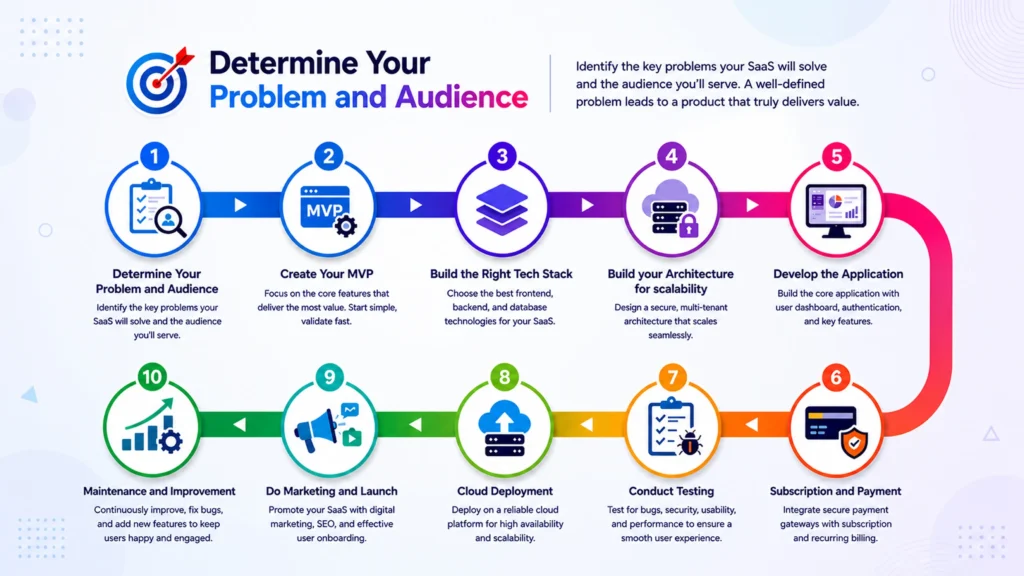
Creating a SaaS application means building software that users can access online and pay for on a subscription basis. The entire SaaS application development process can be broken down as follows:
Determine Your Problem and Audience
Figure out what issues will be solved by your SaaS application. Understand who your users will be and in what ways your product will offer value to them. The most successful SaaS applications are developed with well-defined niches in mind.
Create Your MVP
Determine the most important features that you will include in the initial version. Remember, it’s better to underbuild than overbuild.
Build the Right Tech Stack
Figure out what you’re doing with the frontend, what you’re doing on the backend, and what database you’re building on. Good stacks for SaaS applications include AWS and Firebase (which are cloud databases).
Build your Architecture for scalability
You want to set up multi-tenant users with secure data that can process seamlessly.
Develop the Application
SaaS application development starts with building the application (user dashboard, along with user authentication and payment integration) that provides the application’s core value.
Subscription and Payment
SaaS subscriptions and payments can be handled by payment gateways with recurring/subscription payment features like Stripe and Razorpay.
Conduct Testing
Check the application for bugs and perform security, usability, and performance testing.
Cloud Deployment
For reliability and seamless scalability, deploy your SaaS application on cloud platforms (AWS, Azure, or Google Cloud).
Do Marketing and Launch
Get your product in users’ hands and use digital marketing, SEO, and user onboarding to increase adoption.
Maintenance and Improvement
Never stop making improvements, whether it be in bug fixes, new user-requested features, or minor updates. This is the ballpark that companies must operate in to retain/preserve their customers.
SaaS vs. Clone Apps: Which One Should You Choose?
SaaS vs. clone applications: Which to choose depends on your company’s goals and time as well as your budget constraints. SaaS applications are the way to go if you aspire to build a globally scalable software product. They come with a high investment cost and extended timelines but huge rewards in terms of growth and easily recurring revenue. If you’re looking for rapid entry in a market with lower revenue aspirations, a validated clone app takes the cake. Due to lower cost of entry and minimized risk, clone apps in the domains of food delivery, e-commerce, and ride-hailing are a go-to. For more enterprise and development level aspirations, SaaS is the right one.
Final Thoughts
The SaaS and clone app discussion is less about right and wrong and more about what suits your business. SaaS will give your business growth potential, more revenue, and business flexibility. Clone apps, on the other hand, offer tools to help your business break entry barriers. By recognizing the benefits of SaaS and clone app development, entrepreneurs can gain insights into the subject. When considering your options around how to build a SaaS app, your business can implement structures of value, sustainability, and growth. The choice of app development is guided by your business priorities. Make your choice based on which is more imperative: immediate app launches or a tool to help your business grow?
FAQs
1. Which is faster to launch: SaaS or clone apps?
SaaS platforms are generally faster to launch because a business just has to subscribe to use them. Conversely, clone apps may take more time depending on customization requirements.
2. Can I customize a clone app?
Yes, clone apps are highly customizable. Most clone app development companies customize them according to businesses’ specific requirements.
3. Is SaaS better for startups?
SaaS is often preferred by startups looking for a quick launch and low technical maintenance, while clone apps are chosen for full control and scalability.
4. Do SaaS and clone apps require coding knowledge to use or manage?
No, both SaaS and clone apps can be managed without deep technical knowledge. This is because both platforms provide dashboards and user-friendly admin panels for operations.
5. Which model is more cost-effective in the long run?
SaaS usually has lower upfront costs but ongoing subscription fees. On the other hand, clone apps require a higher initial investment but can be more cost-effective over time due to ownership and customization.

 +91-9464826889