

Whether you have a delivery service, a fleet to manage, or you own an e-commerce business that requires shipping. How you manage your logistics can determine your company’s revenue and your customers’ happiness. This is where knowing how to build a logistics app can be truly beneficial. With the right transport and logistics app, companies can conveniently manage deliveries and workflows, track shipments, manage drivers, and keep them updated, all from one app. This blog will provide you with the essentials of logistics apps, including what they are, popular features, who the users are, and legitimate strategies to develop one.
What Is a Logistics App?
A logistics app is a web- or mobile-based solution for businesses to handle the transportation of products all the way from the warehouse to the customer. It combines all the segments of a supply chain: drivers, dispatch workers, warehouse personnel, and the end users. According to Wikipedia, a supply chain network is. The digital tools used in logistics can enhance the operation of supply procedures through improved delivery, transport, and storage phases within the supply chain. A logistics application enables businesses of all types and sizes to access this capability.
Why Logistics Apps Matter for Businesses Today
The logistics sector has developed fast with developments like online shopping, instant delivery, and worldwide supply chains. There is now a demand for real-time shipment tracking, accurate estimates for delivery, and shipment progress tracking. Businesses that can’t meet these expectations quickly lose customer loyalty. It shows that many companies report 20 – 30 % faster delivery and 15 – 25 % cost savings to operations as a result of their digital logistics integration. Customized logistics platform development allows businesses to meet customer demand without the reliance on slow and tedious manual coordination.
Key Features Every Logistics App Needs
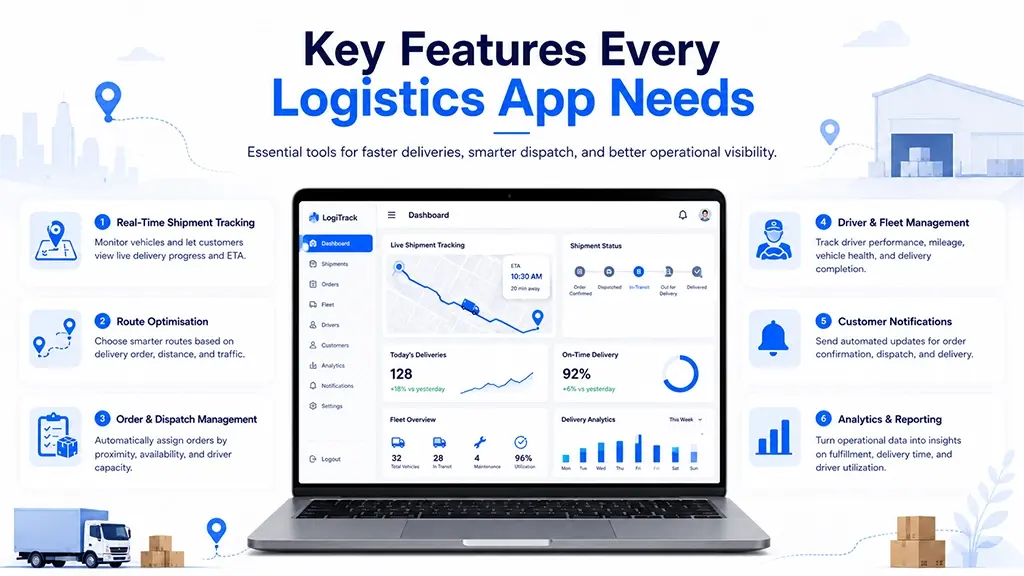
Real-time shipment tracking
Live tracking gives dispatch teams the ability to oversee each vehicle and gives customers the ability to see where their delivery is and the expected arrival time. This has the additional benefit of reducing the number of customer calls and increasing customer trust.
Route Optimisation
Smart routing determines the best path to each drop given the delivery order, total distance, and total traffic. This increases on-time delivery and reduces total fuel costs.
Order and Dispatch Management
The app automatically assigns orders based on the proximity, availability, and capacity of the drivers. This significantly reduces the time needed to manually assign orders.
Driver and Fleet Management
Fleet managers can monitor driver performance, vehicle health, mileage, and delivery completion from one dashboard. This visibility helps identify problems early and allows quicker management decisions.
Customer Notifications
With automated touchpoints for each order milestone, order confirmation, delivery notification, and delivery confirmation. Customer complaints decrease, and customer satisfaction increases.
Analytics and Reporting
A functional logistics app provides a suite of analytics that translate operational data into key insights. Visual analytics on operational KPIs such as order fulfillment, average delivery time, and driver utilization are as easy as opening an app.
Who Benefits from a Logistics App?
Logistic application development is not just for large courier companies. Many types of businesses benefit:
E-commerce businesses are managing last-mile delivery to customers.
Grocery and food delivery platforms that need fast, time-sensitive dispatch
Pharmaceutical companies that require cold-chain monitoring and strict delivery windows
Freight and trucking businesses handling long-haul and multi-stop routes
Retailers offering same-day or next-day home delivery
Third-party logistics (3PL) providers coordinating deliveries for multiple clients
Why Choose a Logistics App Development Company?
Building a logistics app from scratch requires expertise in GPS integration, real-time data handling, multi-user panel design, and scalable infrastructure. Working with a logistics app development company, you gain a team with functional logistics knowledge, which is required for building robust logistics applications. The best logistics app development services extend from the development of user-friendly design and interfaces to the actual app creation, from real-time system maintenance and monitoring to user support. As a result of this holistic service, your logistics app will always remain adaptable and operational.
How Clone-Based Development Speeds Things Up
One of the smartest ways to launch a logistics app faster is to start with a proven clone-based foundation. Instead of building from scratch, the clone app development approach gives you a ready-made, tested platform that you can customize to your brand and business model. If you want to understand, how much does it cost to build a logistics app that meets the solutions that actually fit your budget and the goals of your company? Smart logistics app development solutions can help you achieve your desired target.
Conclusion
Logistics apps are no longer the domain of the large enterprise. Every company that moves products needs one, and a good logistics app solution will give you an edge, visibility, and reliability in your entire delivery operation from dispatch to customer.
Frequently Asked Questions
What is a logistics app, and what does it do?
A logistics app enables businesses to manage deliveries, track vehicles and orders, and update customers, all on one platform.
How much does logistics app development cost?
The cost depends on features, platforms (Android, iOS, or both), and development approach. Clone-based logistics app development services are typically faster and more affordable than building from scratch.
What are the most important features in a logistics app?
The main features logistics apps should have are real-time GPS tracking, route optimization, dispatch management, driver monitoring, customer notifications, and analytics.
Who needs logistics mobile app development?
E-commerce businesses, food and grocery delivery platforms, freight companies, retailers offering home delivery, and any business managing regular shipments can benefit.
How long does it take to build a logistics app?
With a clone-based approach through a logistics app development company, businesses can often launch in 2-3 weeks. A fully custom build typically takes longer, depending on the features required.

Aman kumar
Aman is a Content Writer/Strategist with over 3 years of experience creating content that drives engagement, builds brand authority, and supports business growth. Having worked in both agency and in-house environments, he understands how to develop content strategies that align with business objectives while meeting audience needs.


