





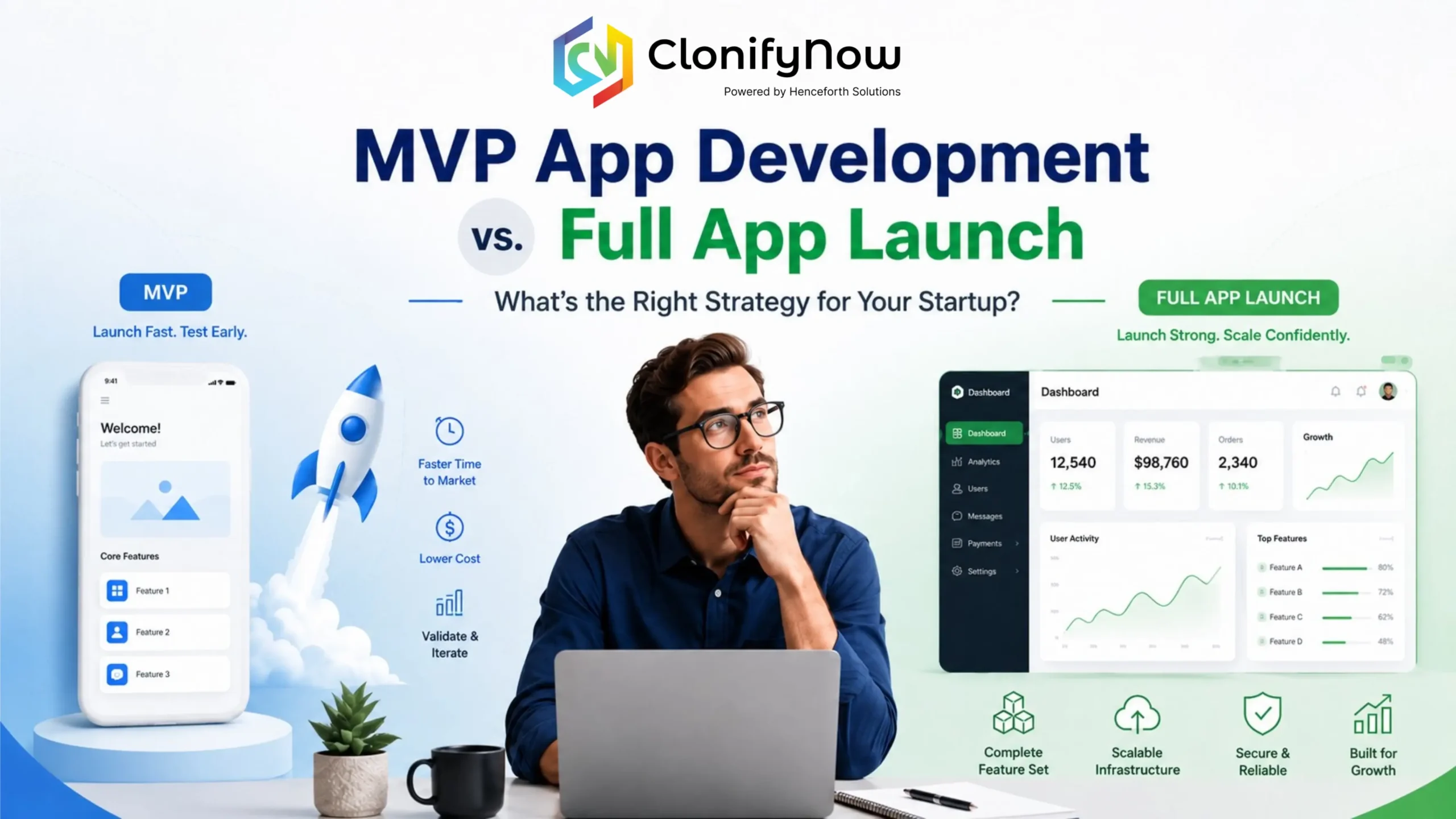
Any successful startup is an idea that has been brought to life. One of the first of many decisions after that is whether to create a fully functional app or to start small and test the waters. This is where the MVP app development strategy comes into play. This strategy has allowed many businesses to roll out and focus on a smart spending strategy that allows sustainable growth. In this blog, we explain what an MVP is, what a full app launch is, when to use them, and how to determine which is better for you.
What Is an MVP?
MVP is short for Minimum Viable Product. It is simply a barebones app to satisfy a single need for your target users to achieve product/market fit. The purpose of an MVP is never perfection. Rather, it is to gain the most amount of insight as quickly as you can as to how a product can be continually improved. MVP is an iterative process. Think of it as a smart test. Instead of guessing what users want, you release the core idea first and learn directly from the market. That is why many startups begin with a focused version of a clone app development before expanding features later.
What Is a Full App Launch?
A full app launch is the ability to build and release an app that is fully designed and production-ready. From the start, an app with a full launch includes a finished design, many features, a fully developed infrastructure, and scalable features to help it grow. This is most effective when there already exists knowledge about the market, audience, and the problem being solved. With most early-stage startups, this level of certainty is uncommon, leaving a full launch as a high-cost and high-risk development method for an idea that has yet to be proven.
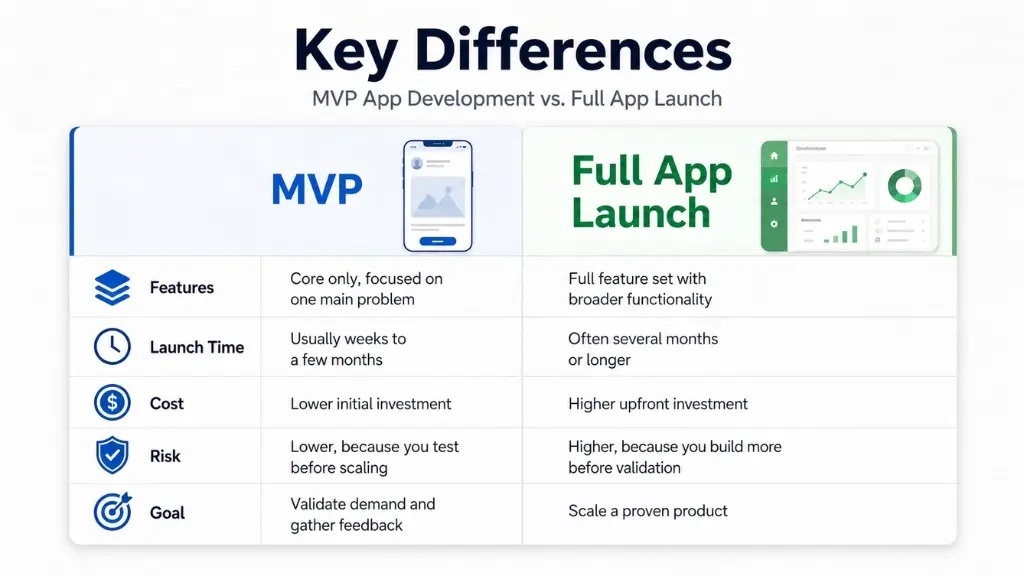
Key differences
Factor | MVP | Full App |
Features | Core only, focused on one main problem | Full feature set with broader functionality |
Launch time | Usually weeks to a few months | |
Cost | ||
Risk | Higher, because you build more before validation | |
Goal |
When should startups choose MVP app development?
For most early-stage startups, the most suitable option is MVP app development. This is ideal for a startup that is working with a new idea, has a limited budget, and has not yet proven that the product is viable and that people will actually use it.
The choice to pursue an MVP is best signaled by the following:
- There are no existing paying customers or a clear demand for the product.
- A launch is needed as soon as possible to begin the learning process with the users.
- Development costs and risks need to be kept to a minimum.
- Traction in the market is needed to have more productive conversations with investors.
- There is an immediate need to enter a competitive market.
A good MVP app development company will help keep development costs to a minimum by recommending the appropriate scope and helping you keep the feature set to a minimum in order to achieve a quicker launch without sacrificing quality.
When does a full app launch make sense?
A full app launch can still be the right choice in some situations. If demand is already proven, your market is well understood, and your startup has strong funding, then a full build may help you compete more aggressively from the start. This approach also makes sense in industries where incomplete products cannot go live easily, such as healthcare or fintech, where compliance and reliability matter from day one. In these cases, a staged rollout or beta test is still often recommended, even if the product is built more fully from the beginning.
The role of an MVP development company
The right MVP development services do more than build screens and features. They help you define what matters most, remove what is unnecessary, and shape a launch plan around user learning instead of feature overload. A strong MVP development company also helps you think beyond launch. It can guide product strategy, UI/UX, testing, and the next phase of scaling once the MVP proves demand. This is especially useful for startups that utilize clone app development as a foundation because the base design is already proven and can be easily modified. This approach is supported by lean startup methodology, which values short build-measure-learn durations over long cycles of development predicated on silos of assumptions. As a result, using an MVP is prudent for startups that are focused on speed and measured demand prior to making value-added investments.
Conclusion
For most startups, starting small is the smartest option. MVP app development is a faster, cheaper, less risky way to test your idea with real potential users and receive their feedback before you commit to building a full product. By waiting to do a full app launch, you can gather user feedback, market proof, and the confidence to invest more before any further app development. The best startups build what is most essential first, learn from their first build, and grow their startup with the feedback they have received.
FAQs
1. What is MVP app development in simple words?
An MVP is the most basic version of an app that includes the core features. It allows you to launch an app and collect feedback from users.
2. Is an MVP cheaper than a full app?
Yes. An MVP is cheaper because it doesn’t include the entire product and only provides a version with the most essential features.
3. How long does it take to build an MVP?
The time to develop an MVP depends on the features it includes. It can take from several weeks to a few months.
4. Can an MVP become a full app later?
Yes, there is a pathway for an MVP to become a full app, and the majority of successful apps begin this way. The target audience is what guides the growth.
5. Why hire an MVP development company?
A good MVP partner helps you define the right features, avoid overbuilding, launch faster, and prepare for future scaling.


 +91-9464826889