






Uber announced plans to launch London’s first robotaxi service in partnership with AI startup Wayve, marking a major step toward driverless urban mobility in Europe.
This highlights how AI, autonomous driving, and smart mobility are reshaping the future of transportation.
For startup founders, business owners, and enterprise decision-makers, starting a digital mobility platform is a tremendous revenue opportunity. But moving from a business plan to a live product requires complicated technical choices, monetization models, and infrastructure requirements.
On demand taxi app development comes with the logistics of whether to build a product from scratch or use modern pre-built frameworks. If you want to get a high ROI, engineers should work on scalable backend architecture, optimized matching algorithms, and low-latency geospatial data systems.
On-demand taxi booking app development
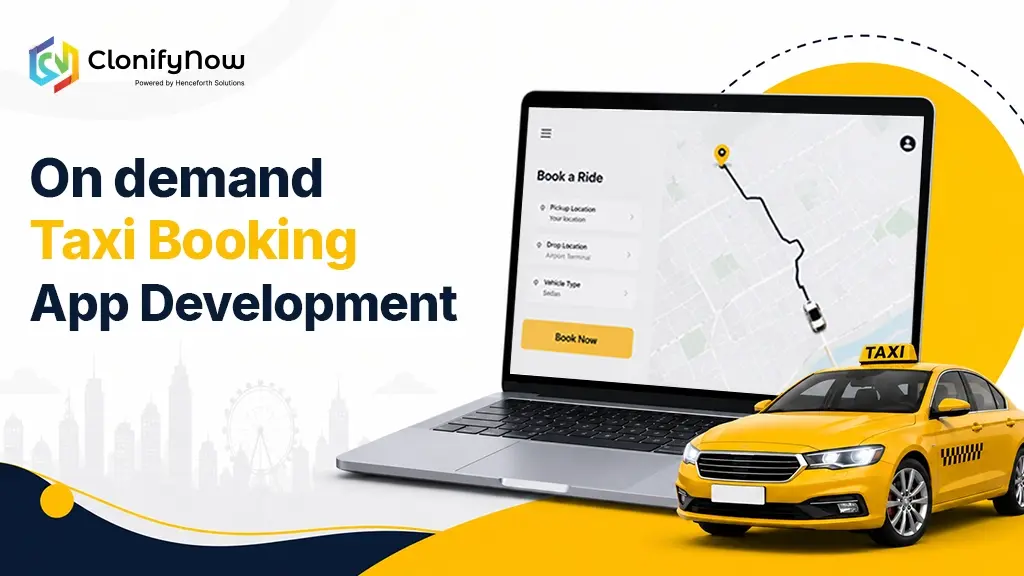
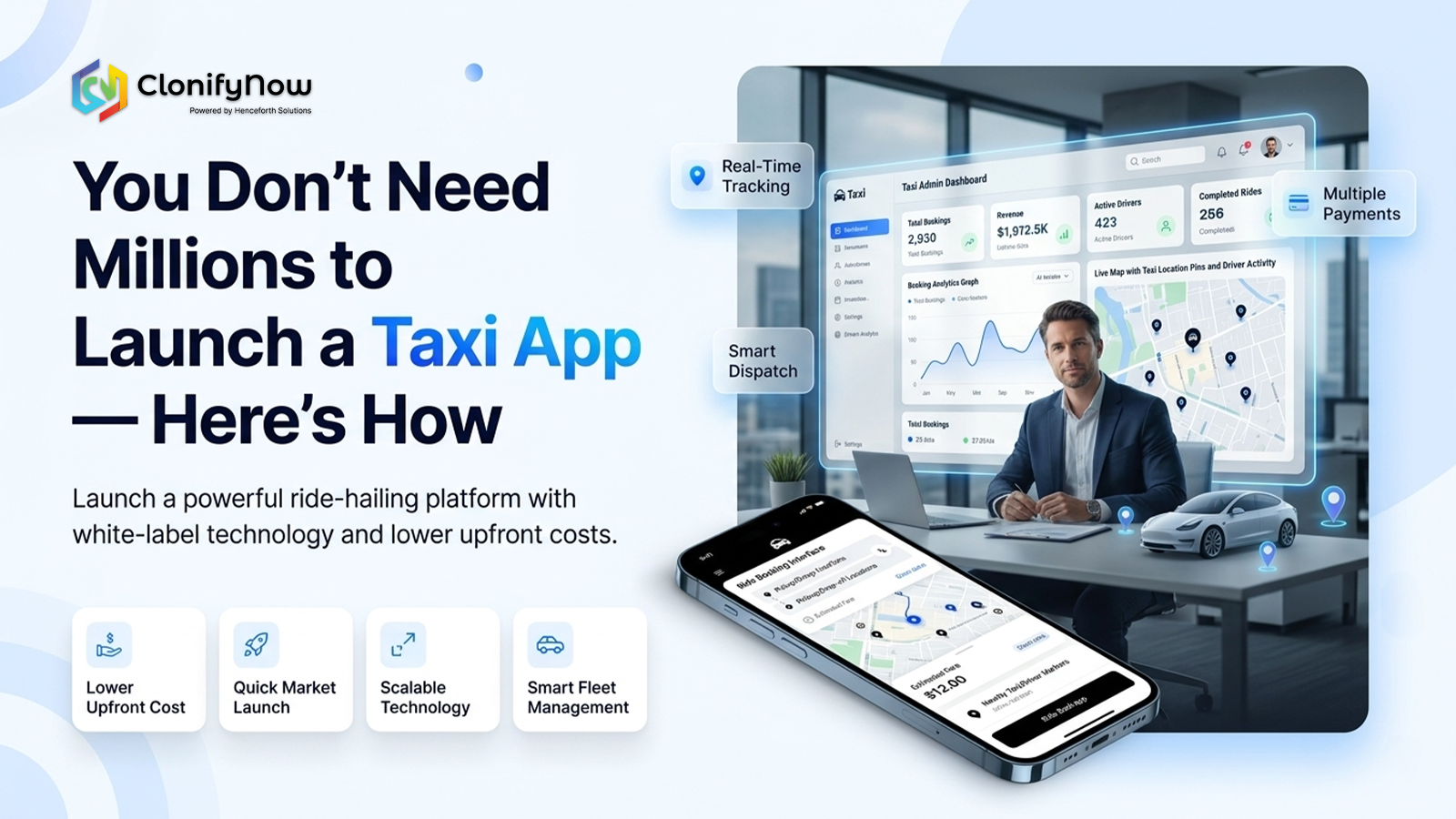
To establish a successful platform, an interlinked digital ecosystem needs to be deployed. There is a misconception that a taxi platform is just one app. In fact, creating a complete on-demand taxi booking app development requires 3 different but coordinated components, namely Passenger App, Driver App, and the Central Administrative Panel.
The Passenger Application Architecture
The customer-facing application must be very simple and give low-latency feedback. Users expect to open the application, see the available vehicles in real time, and order a trip with minimal interactions.
- Geofencing & Geospatial Search: Locate passengers with precise coordinate tracking and dynamically define service zones.
- Dynamic Fare Estimates: Calculating distances, estimated times, and live traffic conditions before a passenger books with routing APIs.
- Multi-Channel Payment Gateways: Integrate secure architectures for credit cards, digital wallets, and localized payment networks.
The Driver Application Architecture
The driver’s portal is a high-performance workspace for field operations. It needs aggressive battery optimization, constant background location, and fast UI state changes.
- Real-time demand: Heatmaps display geographic high-demand zones to help drivers find surge pricing areas.
- Instant Trip Dispatch Systems: Efficient push messaging frameworks to dispatch trip requests in a short window.
- Daily Earnings Analytics: Drivers get a clear breakdown of completed trips, calculated tips, and platform fees.
The Central Administration Dashboard
Your whole fleet is coordinated by the administrative engine. Built as a powerful web application, it allows operations teams to monitor, audit, and optimize their daily workflows.
- Automated Matching Algorithms: Matching incoming ride requests with the nearest available driver, considering distance and route history.
- Surge Pricing Engines: Automatically increasing fares when demand for rides exceeds local driver supply in designated geofences.
- Full Financial Accounting: Managing auto driver payments, commission deductions, and promo code tracking.
On demand taxi booking app development
When structuring an enterprise-grade project, business leaders need to think of on demand taxi booking app development as an exercise in building scalable software systems. The tech stack has to support huge data flows, varying server loads, and complex geo-location streaming without losing a single connection.
Choosing the Ideal Technical Infrastructure
The core components of a high-performance taxi booking system rely on a solid technology foundation:
| System Layer | Recommended Technologies | Business Purpose |
| Mobile Frontend | Flutter, React Native, Swift, Kotlin | Cross-platform flexibility or deep native performance |
| Backend Framework | Node.js, Python (Django), Go (Golang) | High concurrency management and fast API responses |
| Database Engine | PostgreSQL (PostGIS), MongoDB | Storing relational user profiles and spatial indexing |
| Real-Time Data | WebSockets, MQTT Protocol | Constant live coordinate streaming between apps |
| Cloud Hosting | Amazon Web Services (AWS), Google Cloud | Automated server scaling and data backups |
Advanced Features That Drive Business Conversions
In a competitive market, on a modern platform, it takes more than basic ride requests to capture market share. Implementation of advanced software logic greatly enhances customer retention and maximizes business profits.
AI-Driven Route Optimization
Traditional routing systems provide the shortest visual distance. Modern architectures use predictive machine learning models that process past traffic patterns, construction, and weather variables to recommend the fastest routes to drivers.
Intelligent Ride Pooling Systems
Carpooling logic is complex database matching. The system must analyze each ride request individually in real time, compute overlapping geographic trajectories, and match passengers going the same way without adding significant delay to the initial user’s ride.
On demand taxi app development company
Finding the right technology partner is the most critical decision of your business lifecycle. Partnering with a professional on demand taxi app development company such as ClonifyNow safeguards your capital, accelerates product deployment, and prevents expensive structural re-engineering down the road.
What to Look for in an Engineering Partner
More than just lines of code, a top development group offers strategic consulting, rigorous QA testing, and scalable architecture design.
- Proven Geospatial Experience: The engineering team should have extensive hands-on experience with real-time GPS tracking and map integrations.
- Strict Security Measures: Mobility apps handle sensitive customer records, financial tokens, and live location feeds on a continuous basis. Adherence to data security frameworks such as GDPR, PCI-DSS, etc.
- Scalable Backend Design: Your platform must be stable during high commuter spikes. Microservices architectures are used by top agencies to stop single server loads from bringing down the entire system.
This is exactly where ClonifyNow excels. We are a proven leader in the on-demand product ecosystem, providing highly optimized, thoroughly tested mobile frameworks to help startups and enterprises deliver stable platforms to the market in record time.
White label taxi app vs custom development cost
A key strategic decision for any executive is to buy an off-the-shelf system or build custom software from the ground up. Choosing a white label taxi app vs custom development cost is a question of balancing your short-term time-to-market goals against long-term product control.
Strategic Launch Path Comparison
Choosing between these two models alters your business timeline and budget allocation dramatically.
| Metric | White Label / Clone Model | Custom Development |
| Time to Market | 7 to 14 Days | 6 to 12 Months |
| Upfront Capital | Very Low / Monthly Subscription | Very High ($50,000 – $150,000+) |
| Source Code Ownership | Hosted/SaaS or Package License | 100% Proprietary Ownership |
| Maintenance & Patches | Handled by Vendor | Handled by the Internal Dev Team |
| Scalability | Pre-optimized for High Loads | Custom Architected from Scratch |
The Cost Realities of Custom Development
Creating a world-class mobile app system from scratch takes months of hard work, research, architectural design, coding, and endless test phases.
- Extended Timelines: Custom builds typically require 6 to 12 months of active engineering effort before an MVP is ready for public beta launch.
- Big money: Building full cross-platform apps with a heavy admin engine could cost anywhere from $50,000-$150,000+ depending on where your team is and how complex the features are.
- High Post-Launch Overhead: Keeping custom infrastructure alive requires dedicated dev teams to manage server maintenance, patch security bugs, and update OS compatibility.
The Smarter Alternative: High-Value Pre-Built Frameworks
For founders looking to launch fast, avoid heavy up-front debt, and test market demand, a turnkey solution is the standard today. This means you don’t have initial engineering roadblocks using proven, white-label frameworks.
To help startups scale efficiently, ClonifyNow’s transparent pricing tiers to match any stage of business growth:
| Pricing Plan | Estimated Cost | Best For |
| Starter Plan | ₹3,999 / month | Early-stage startups needing a quick launch with essential operational features |
| Growth Plan | ₹7,999 / month | Expanding operations require advanced control, analytics, and engagement tools |
| The Bundle Deal | ₹50,000 (One-Time) | A complete package providing full Customer and Driver mobile applications |
Key Financial Consideration
Watch out for hidden fees when considering the white label taxi app vs custom development cost. Turnkey frameworks typically do not include third-party operational costs such as payment gateway transaction fees, SMS API routing, and push notification delivery networks. Always set aside a small secondary operational fund to address these external variables.
Strategic Steps for an Impactful Market Launch

After deciding on your technology options, a well-structured roadmap of operations in phases is necessary to turn your mobile app into a money-making business.
In-depth Target Market Research
Don’t build a product for “everyone.” Examine specific regional gaps. Your local entry strategy could be a corporate luxury chauffeur service, specialized non-emergency medical transport, eco-friendly electric vehicle fleets, or low-cost regional deliveries.
How to Drive High Conversions with Seamless UI Design
Friction kills user adoption. Improve your onboarding flows, let users log in with social media with ease, show pricing sheets upfront, and use clear visual animations that show you exactly when a driver will arrive.
Infrastructure for Sustainable Growth
Build sustainable growth beyond your launch week by using viral referral loops in your app. Reward riders for referring friends with ride credits and set clear driver bonus milestones to maintain healthy fleet retention on your network.
Summarizing Your Path Forward
To get a top position in the mobility sector, you need to achieve the right balance between technical performance and meticulous financial planning. The right technology infrastructure and an elite software development team are necessary for successful execution.
Grasping the real mechanics behind on demand taxi app development will save your venture from big cost overruns and long delays in development. With ClonifyNow, you leverage proven production-ready frameworks from a trusted provider to go live in days, preserve your working capital and focus your energy where it matters most: acquiring users, managing your fleet and capturing local market share.
FAQs About On Demand Taxi App Development
Why are AI-powered taxi apps becoming popular among startups?
AI-powered taxi apps reduce operational costs, enhance route planning, boost customer satisfaction, and help startups scale faster against established ride-hailing competitors through intelligent automation.
Why are founders investing in autonomous mobility platforms?
Autonomous mobility is a long-term growth opportunity for founders, as it can help to reduce dependency on drivers, increase operational efficiency, and build up scalable transportation businesses fuelled by AI technologies.
How can startup founders prepare for the future of ride-hailing?
For startup founders, this means investing in scalable app architecture, AI integrations, real-time analytics, and flexible business models that can adapt to autonomous vehicles and shifting mobility regulations.
What features do business managers prioritize in modern taxi platforms?
Competitive markets demand fleet management, AI-powered dispatching, driver performance monitoring, dynamic pricing, and customer analytics from business managers looking to boost profitability and operational efficiency.
Will autonomous taxis replace traditional ride-sharing businesses?
The most likely first step for self-driving taxis will be as an add-on to existing ride-hailing services. Building on AI-ready platforms is a smart move for startups now, positioning them to capitalize when autonomous mobility becomes commercially viable.


 +91-9464826889