

If you’re considering launching a meal delivery service, one of your first important decisions will be whether to go for a single restaurant model or a multi-restaurant marketplace. Each option uses comparable underlying technologies but pursues quite different business strategies, targets customers, and operational objectives.
The main difference boils down to control vs. variation. Your kitchen. Your menu. Your customers. The only restaurant app you need. A multi-restaurant marketplace is a platform that connects several food providers with hungry clients in a larger area.
Selecting the wrong model from the outset might lead to budget drain and operational issues. This article analyzes both approaches on operational complexity, initial investment, revenue models, and growth potential to help you choose the appropriate fit for your organization.
Understanding the Single-Restaurant App Model
Single restaurant food ordering software is meant for an individual bistro, dark kitchen, or local restaurant chain. Your app is a dedicated digital storefront for your own food, rather than competing with dozens of other restaurants on a shared platform.
The user journey in this approach is simple: the user opens your app, looks at your menu, places an order, and pays directly. Your kitchen receives the order, cooks the food, and sends it out via your own delivery personnel or a local logistics partner.
Major Benefits
Zero third-party commission fees: third-party aggregators normally charge 15-30% on every order. When you operate your own platform, you keep 100% of your menu margins.
Ownership of Direct Customer Data: You’ll have complete access to customer contact information, order history, and preferences, making targeted marketing and loyalty efforts a lot easier.
Complete Brand Control: Your brand personality is represented on every screen, push notification, and packaging element with no rival distractions.
Challenges to consider:
Limited Audience Reach: You have to generate 100% of your app’s traffic through your own marketing efforts.
Delivery Logistics Management: You take care of order fulfillment, either with full-time drivers or by leveraging third-party delivery dispatch services.
Understanding the Multi-Restaurant Marketplace Model
Multiple-restaurant marketplace is like a virtual food court. Uber Eats, Deliveroo and DoorDash are examples of aggregators that bring many independent restaurants together in one single mobile app.
You operate as the platform operator instead of cooking the dish yourself. Restaurants sign up to have their menus listed on your site, clients browse a huge variety of cuisines, and independent delivery drivers deliver the orders.
Key Benefits
Strong User Appeal: People love installing programs with multiple options. More cuisines at one spot means more user retention and app usage.
Scalable Platform Business: No limitations in kitchen capacity. As more restaurants get onto your app, you may sell more orders without needing to buy equipment or lease a larger physical site.
Multiple sources of revenue: You can make money from delivery fees, vendor commissions, highlighted restaurant ad listings and customer subscription passes.
Challenges to be aware of
Increased Operational Complexity: You will have to juggle three different user groups at the same time – customers, restaurant vendors and delivery partners.
More Initial Effort: You’ll need to onboard vendors before you have a huge consumer base, meaning you’ll need to have strong local sales outreach early on.
Core Features: How the Two Models Compare
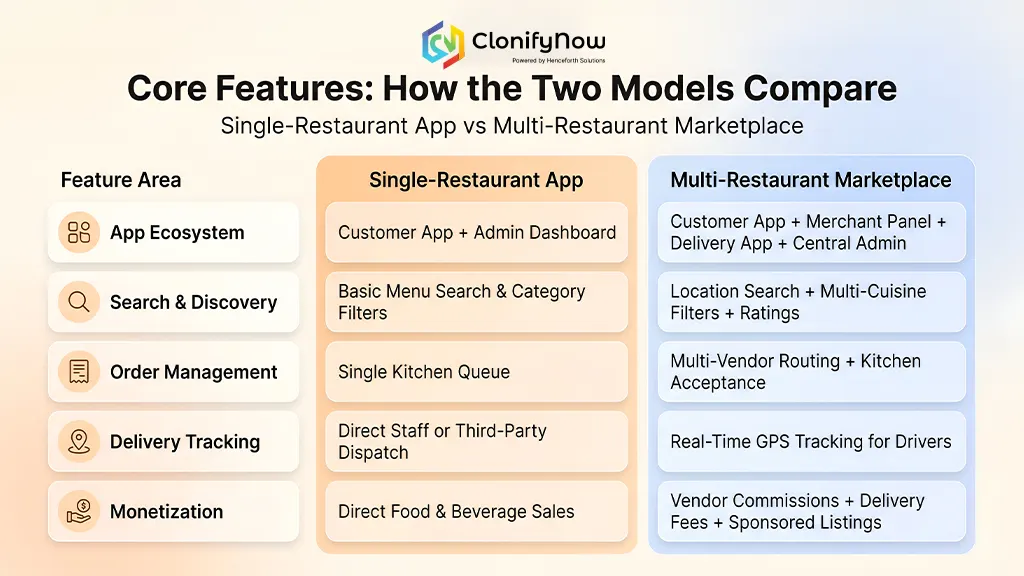
While both models rely on food delivery technology, their feature sets differ based on who is using the app.
Feature Area | Single-Restaurant App | Multi-Restaurant Marketplace |
|---|---|---|
App Ecosystem | Customer App & Admin Dashboard | Customer App, Merchant Panel, Delivery App & Central Admin Panel |
Search & Discovery | Basic menu search and category filtering | Advanced location-based search, multi-cuisine filters, and ratings |
Order Management | Single kitchen queue management | Multi-vendor order routing and kitchen acceptance management |
Delivery Tracking | Direct staff tracking or third-party dispatch | Real-time GPS tracking for independent delivery drivers |
Monetization Setup | Direct food and beverage sales | Real-time GPS tracking for independent delivery drivers |
Comparing Costs, Setup, and Maintenance
Usually you need less start-up money to launch an app for a single restaurant because the software process is less complicated. You simply need to design a customer-facing ordering interface and a streamlined management dashboard for your culinary crew. Your current crew is able to respond swiftly to changes in menus or opening hours.
Multi-restaurant platform demands a more extensive software architecture. You need specific mobile apps for consumers and delivery drivers, and online panels for restaurant partners and platform admins.
It takes six months or more to build these complicated software modules from scratch. Many entrepreneurs that employ a pre-built Uber Eats clone script for faster launch times and lower initial software expenses can utilize ready to use apps for consumers vendors and delivery partners and tweak them with their own branding.
Which Business Model Should You Choose?
The choice between these two approaches depends on your current business strategy and your growth goals.
Opt for a Single-Restaurant App If:
You are running an existing physical restaurant, cloud kitchen, or bakery chain.
Your major objective is to create direct client contacts and not to pay huge commission costs to delivery aggregators.
You want to keep a narrow delivery radius around your current kitchen site.
Select a Multi-Restaurant Marketplace
You’re a startup or entrepreneur trying to establish a platform business in your city or region.
You want to monetize local food delivery traffic without the need to run the kitchen or food inventory yourself.
You have a plan for sourcing local restaurant vendors and promoting the platform to consumers in your target market.
If you are an entrepreneur who wants to start quickly, you can use platforms from solution providers like ClonifyNow, which offer modular setups for direct ordering for a single restaurant and marketplace configurations for multiple vendors as your business grows.
Conclusion
Neither model is fundamentally superior than the other, they only fulfilll different commercial purposes. A single-restaurant app protects your profit margins and builds client loyalty for an existing kitchen. A multi-restaurant marketplace offers better revenue possibilities and scalability that connects a whole local food ecosystem.
Before you decide, consider your budget, operational capacity and long-term business goals. Having an understanding of what you are focusing on from the start can help you develop a food delivery platform that fits your market.
Frequently Asked Questions
Can one restaurant app be transformed into a multi-restaurant marketplace in the future?
Yes, however that usually means upgrading your database architecture and adding new modules to the app, such as vendor panels and driver dispatch systems. If you anticipate on growing at some point then starting off with a flexible software base will make expanding much easier.
How Multi-Restaurant Apps Make Money?
Multi-restaurant platforms make money in a variety of ways, including commissions on each restaurant order, flat delivery fees from customers, sponsored search listings for restaurants, and monthly subscriptions.
How long does it take to build a meal ordering app?
A custom meal ordering app development from scratch may take four to eight months. But establishing and branding a ready-to-launch clone solution can cut the development time frame to a few weeks.

Aman kumar
Aman is a Content Writer/Strategist with over 3 years of experience creating content that drives engagement, builds brand authority, and supports business growth. Having worked in both agency and in-house environments, he understands how to develop content strategies that align with business objectives while meeting audience needs.

