





The ride-hailing market is a fast-moving one, and one of the most important decisions you will make is how to build your application. For business owners, startup founders, and enterprise decision-makers, the question boils down to a classic dilemma: Do you buy a pre-built solution or build one from scratch?
Did you know? The global ride-hailing market was valued at USD 284.74 billion in 2025 and is projected to reach USD 716.64 billion by 2034, growing at a 10.8% CAGR. This rapid growth is driving more startups and fleet operators to choose white-label taxi apps for faster market entry and lower development costs.
Full breakdown of passenger, driver, and admin features is vital to your success and requires a deep understanding of your business goals, your available budget, and your timeline to market. Both are valid paths to success, but they are for completely different business strategies.
White label taxi app vs custom development
In order to make an educated decision, you need to understand what each model offers.
White-label taxi application: A ready-made, pre-coded software solution. The basic code structure, the user screens, and the backend are already built and tested. This foundation is then rebranded by a development partner with your specific brand name, company logo, colour scheme, and corporate identity. It helps you get your business off the ground quickly without spending months on initial product design and core programming.
Custom taxi app: On the other hand, it is built from scratch. Each feature, user interface screen, and system of the backend architecture is designed especially for your company. This is the path usually followed by companies with proprietary algorithms, complicated legacy systems, or unique business logic that require a custom digital infrastructure.
Comparing custom taxi apps and white label taxi solutions is like comparing buying a custom-built, customizable modern home to designing and laying the bricks for a new house from scratch.
White label taxi app vs custom development advantages
Operational priorities differ across business structures. Which one you choose will depend largely on whether you want immediate market entry or longer-term structural absolute ownership.
Advantages of White Label Solutions
Deployment can take days or weeks, not months, because the software infrastructure is already in place.
- Accelerated Time to Market: You can steal market share before your competitors have even finished their design phase.
- Fully tested infrastructure: Ready-made applications are already in use in real-world situations. It means the common bugs, payment gateway glitches, and GPS synchronization tracking issues are already resolved.
- Lower financial risk: With less money required upfront, you can spend more of your capital on local driver acquisition, customer marketing campaigns, and day-to-day business operations.
- Included Long-Term Maintenance: Many businesses choose a cab taxi app for faster market validation and expansion. It offers regular technical support, security updates, and operating system compatibility patches as part of its package infrastructure.
Advantages of Custom Development
- Total Strategic Control: You have every line of code. This means you can change the underlying architecture whenever your long-term business objectives change.
- Custom Feature Engineering: If you have a very specialized feature in your business model (e.g., a custom corporate billing system, a custom local dispatch algorithm), custom development enables you to develop it without any constraints.
- Infinite Scalability Options: Great white-label solutions scale incredibly well, but custom builds allow your internal engineering teams to modify server setups exactly as your traffic dictates.
When comparing custom taxi app vs white label solutions, white-label software provides the competitive advantages that startups and regional fleets need to survive early-stage growth, while custom builds suit massive global operations with massive capital reserves.
White label taxi app vs custom development cost

For most enterprise decision makers and founders, the bottom line is financial reality. The cost difference between the two approaches is massive and will directly impact your runway and profitability timeline.
Understanding the Custom Cost Structure
To create a custom taxi booking app from scratch, you need to hire a full team of UI/UX designers, front-end developers, back-end engineers, QA testers, and project managers. You have to pay for every hour of research, wireframing, coding, and debugging. A custom ride-hailing platform developed from scratch typically starts from $40,000 and can go well over $150,000 globally, depending on complexity and regional developer rates.
Breaking Down Ready-Made Pricing Models
Partnering with a White Label Taxi App development company simplifies long-term technology management. Let’s take ClonifyNow as an example, a reliable provider of on-demand software solutions that offers powerful tech stacks at a fraction of the price.
| Feature Metric | White Label Solution Model | Custom Development Model |
| Upfront Cost | Extremely low (Subscription or small setup fee) | Extremely high ($40,000 to $150,000+) |
| Time to Market | 1 to 3 weeks | 6 to 12 months |
| Core Reliability | High (Pre-tested across thousands of rides) | Requires extensive beta testing phases |
| Brand Identity | Fully customized logos, colors, and themes | Custom-built layouts from zero |
| Source Code Access | Available via premium licensing tiers | Fully owned from day one |
Financial Comparison Note: Unforeseeable third-party integration costs (e.g., SMS gateways, mapping APIs, local payment processing) are common to both development models. But using a white-label package saves a lot in upfront capital.
In the case of custom taxi app vs white label solutions, the cost benefit of ready-made deployment allows you to start your business with predictable and transparent operational expenses.
Strategic Comparison Framework
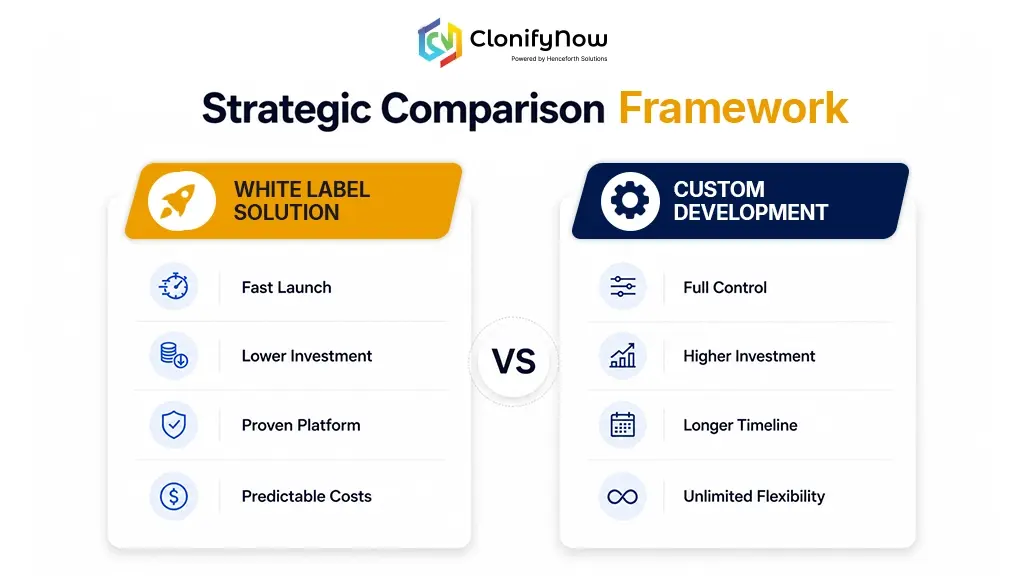
To help you visualize where your business fits best, here is a breakdown comparing the key metrics that determine long-term operational success. Which Path Fits Your Business Strategy?
The right choice of Uber clone app vs custom taxi app comparison depends entirely on where you are in the business lifecycle, the capital you have available to spend, and your long-term scaling plan.
Choose a White Label Solution if:
- You are a startup founder or local fleet operator who needs to launch right now.
- You want to validate a local market without burning all of your seed funding on software development.
- It’s better to have consistent monthly software costs than unpredictable and expensive development cycles.
- As far as software, you need a proven, reliable system like the software ecosystems provided by ClonifyNow with ready-to-go apps for customers, drivers, and central admin dispatchers.
Choose Custom Development if:
- You are a well-funded global company that is going to compete head-on with global market leaders at massive scale, from day one.
- Your business model relies wholly on an entirely new and untested ride-sharing mechanism that off-the-shelf platforms are incapable of supporting.
- You have a large, dedicated in-house engineering team that can do server architecture, bug patching, and security around the clock.
Conclusion
Ultimately, the decision to develop a custom taxi app vs white label solutions comes down to strategic resource management. Your unique, unbuilt tech algorithm is your core value proposition. Go bespoke. But if you’re focused on building a highly profitable, scalable and operationally efficient transport business, a white-label solution is almost always the smartest strategic play.
Platforms like ClonifyNow take away the technical headaches of development and allow you to put your energy completely into what actually generates revenue: onboarding quality drivers, marketing to passengers, and dominating your local market.
FAQs For Custom Taxi App Vs White Label Solutions
White label taxi app vs custom development: Which is better for startups?
A white label taxi app is perfect for startups as it means you can get your app out there faster, with less upfront costs and with proven features, enabling founders to test markets before spending on custom software.
What is the Cost of Developing a Custom Taxi App in 2026?
The taxi app development cost varies depending on the features, integrations, scalability requirements, and the size of the development team. The average cost starts at $50,000 and can go up to $250,000+.
Can the white label taxi app scale up with my ride-hailing business?
Yes. Today’s white label taxi platforms offer multi-city operations, fleet expansion, payment integrations, and high user volumes. It is a good fit for startups, SMEs, and growing transportation businesses.
When to Choose Custom Taxi App Development Over a White Label Solution for Your Business
Custom development is the right choice for your business if you need proprietary algorithms, unique workflows, enterprise integrations, and full ownership of source code that is not possible with configurable white label platforms.
Why are founders moving towards white-label taxi app solutions?
Founders prefer white-label taxi apps. Developing white label taxi apps is less risky, takes less time to market, costs less to operate, and helps founders generate revenue faster in the competitive ride-hailing industry.



 +91-9464826889