


To get into the quick-commerce or logistics segment, one needs a clear strategic vision. The Uber Eats Clone app gives you a functional framework to launch a platform, but the business vertical you choose defines your margin possibilities, capital requirements, and total ROI. Food delivery, supermarket logistics, and parcel courier services all have completely different unit economics, dispatch algorithms, and supply chain restrictions.
Did you know? The global online food delivery market is projected to reach $505.5 billion by 2030, growing at 9.4% CAGR from 2025–2030.
Your choice of which model to scale, or whether to go the hybrid multi-service platform route, shapes your infrastructure expenditures, as well as client acquisition strategy. Before committing development resources, it is necessary to evaluate operational difficulties, unit margins, and market dynamics across these three major verticals.
Market Dynamics Driving On-Demand Delivery App Scalability
The worldwide digital logistics and rapid commerce industries have transitioned from hyper-growth user acquisition to unit-economic viability. Technology professionals who are building an on-demand delivery app need to link the software architecture to the individual market drivers driving each service vertical.
Order Frequency versus Basket Size: Food delivery has a high order frequency with a medium basket size. Grocery delivery is greater basket size with sophisticated multi-item fulfillment. Courier services can be accessed through corporate contracts or on an urgent peer-to-peer basis with a price that varies depending on weight and distance.
Customer lifetime value (LTV): Food platforms have a consistent weekday lunch and weekend supper pattern. Grocery platforms have sticky weekly retention loops, and courier applications rely on recurrent enterprise logistics contracts to lock in income.
Regional Market Densities: High-density metropolitan areas provide the best route efficiency for food and grocery micro-fulfilment. “Point-to-point parcel couriers tend to be more profitable in regional or suburban markets.”
Evaluating Business Models: Food Delivery App Development Considerations
Food delivery app development is a good option to invest in when unit margins are tiny but operational speeds are high. Cold foods get cold and hot foods get tough. Pre-cooked foods spoil fast. The software architecture must support real-time kitchen prep times, tight courier dispatch windows, and dynamic delivery radii.
The income strategy is mostly commissions from merchants (15-30%), delivery fees to the consumer, and sponsored listings on the app to generate exposure for eateries. Margins are razor thin in the restaurant business. So platform operators require high order density and precise regional routing to be viable.
Key technical requirements are constant GPS tracking; split-payment systems that instantly pay drivers and restaurants; and batching algorithms for high-demand times that aggregate adjacent orders without adding delay.
Managing Complex Supply Chains with a Dedicated Grocery Delivery App
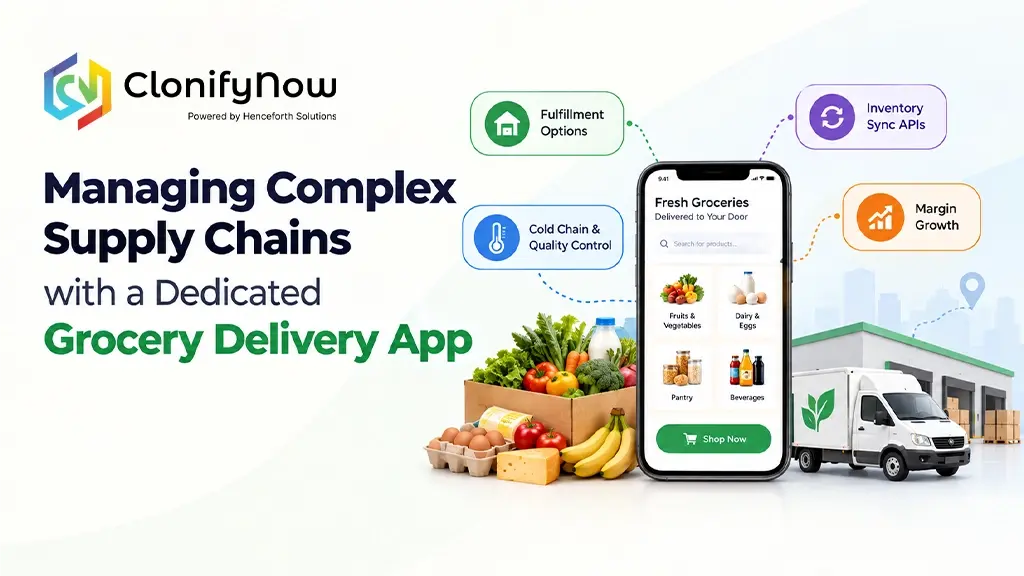
While developing a grocery delivery app, you need to think about inventory management. This is not a problem for a grocery delivery app. Unlike restaurant orders that typically involve a single bag, supermarket orders involve several products across a range of product categories, which means batch picking, sub-minute inventory synchronization, and item substitution logic.
Fulfillment Paradigms: Platforms can choose dark store micro-fulfilment (high capital expenditure, fast delivery), pick from partner merchants (cheap upfront cost, risk of out-of-stock), or hybrid warehouse hubs.
Cold Chain & Quality Control: Clear picking routes are important as well as temperature-controlled logistics for perishable commodities to avoid spoilage and costly return requests.
Inventory Synchronization APIs: Enterprise systems should be integrated directly to warehouse ERPs for stock levels to be updated in real time and users don’t buy products that are unavailable.
Margin Structures: Low unit margins on raw foods (usually 3% to 8%) but overall profitability through high average order values, FMCG brand advertising placements, and delivery membership subscriptions
Scaling Logistics and Operations through Courier Delivery App Development
Opting for courier delivery app development takes your organization to point-to-point transportation, document delivery, and mid-mile business functions. For this market, it’s about shifting the attention away from consumer-facing food menus to load capacity, vehicle class choices, and enterprise account controls.
Platform revenues are calculated by distance-based pricing, volume weight calculation, and dedicated corporate subscriptions. Margin profiles are often higher than food delivery, as delivery reliability and speed are more important to business clients than discounted prices.
Some important features to consider are multi-stop route optimization, digital Proof of Delivery (e-POD) through signature capture or photo upload, automated weight-based fee calculations, and dedicated billing portals for invoice management.
Strategic Comparison Across Delivery Verticals
Operational Factor | Food Delivery | Grocery Delivery | Courier & Parcel Logistics |
|---|---|---|---|
Average Order Value (AOV) | Moderate | High | Variable (Weight/Distance) |
Gross Margin Potential | Moderate (15%–25% commission) | Low to Moderate (3%–12%) | High (B2B contract margins) |
Delivery Time Sensitivity | Extreme (< 30–45 mins) | High (< 15–60 mins) | Moderate to High (Scheduled or Same-Day) |
Fulfilment Complexity | Low (Single merchant pick) | High (Multi-item picking & stock out risks) | Moderate (Vehicle sizing & route routing) |
Primary Monetisation | Commissions, Delivery Fees, Ads | Margin Spread, Subscriptions, Brand Ads | Distance/Weight Fees, Enterprise Retainers |
Implementing Your Platform via an Uber Eats Clone App Infrastructure
Employing a ready-made codebase through the Uber Eats Clone app framework brings about a significant reduction in both the time-to-market and the initial investment compared to the development of a custom-tailored enterprise software solution from scratch. Yet, the management team from Clonifynow needs to implement the solution carefully to comply with the technical aspects of its scalability.
Step 1: Core Architecture & Customisation
Choose a modular solution that enables the application to support multiple users. Adjust various sections of the online application interface, dispatch engine, and payment mechanism according to the needs of the specific vertical chosen.
Step 2: Integration with the System & API
Include third-party solutions such as SMS gateways, mapping APIs, payment providers (Stripe, Adyen), and enterprise ERP systems into the application. In the grocery or food verticals, ensure the direct connection of POS systems with the app to allow the automation of inventory management and menu updates.
Step 3: Driver & Vendor Onboarding
Set up driver-partner and vendor portals. Build reliable verification systems with a number of KYC checks (check of identity, vehicle insurance, presence of any criminal records in the past).
Step 4: Rollout & Load Testing
Conduct rigorous end-to-end stress tests simulating peak demand spikes. Launch within a restricted geographic pilot zone to validate dispatch algorithms, driver allocation speed, and customer satisfaction metrics.
Strategic Recommendations for Decision-Makers
Before you launch your delivery platform, assess your capital reserves, local competition density and long-term enterprise ambitions. If your organization is considering digital delivery solutions, the next step is to examine your technical requirements, budget and scalability goals.
Before you spend money, take some time to think about how the underlying source code will perform under high concurrency. To explore a tested and customized platform that suits your launch needs, check out the strategic features of the ClonifyNow Uber Eats clone solutions to speed up your launch time.
FAQs About Uber Eats Clone App
Which delivery app vertical is the most profitable?
Courier systems can earn better margins in B2B, but food and grocery models are more dependent on order volume, efficiency, and local rivalry.
How Much is an On-Demand Delivery App?
The development cost will depend on the features, integrations, the complexity of the platform, customization, and scalability needs. That is why it is vital to make a complete business assessment before the development starts.
Is Uber Eats Clone Useful For Grocery Delivery?
Yes, an Uber Eats clone can give you the basic infrastructure, but supermarket companies require inventory synchronization, replacement, picking, and fulfillment capabilities.
What characteristics should a courier delivery app have?
Key capabilities include route optimization, real-time tracking, digital proof of delivery, automated pricing, driver management, business accounts, and billing.
Should a business pick one delivery vertical or many?
Companies should start with one clear vertical, prove out the unit economics, drive operational efficiency, and then expand into complementary delivery services.

Aman kumar
Aman is a Content Writer/Strategist with over 3 years of experience creating content that drives engagement, builds brand authority, and supports business growth. Having worked in both agency and in-house environments, he understands how to develop content strategies that align with business objectives while meeting audience needs.


