


Building an enterprise-grade platform means balancing the need for quick time-to-market with long-term infrastructure durability. To launch an on-demand delivery app, you need an architecture that can process concurrent orders, manage complicated dispatch logistics, and ensure high uptime of the platform. Many early-stage enterprises fail not due to product-market fit, but owing to technical debt from adopting fragile combinations of frameworks that are not scalable.
There are trade-offs to consider when choosing the correct basis for your Uber Eats Clone app in terms of speed, cost, maintainability, and concurrency. For executive decision-makers, selecting an enterprise architecture is not only an IT decision; it is a strategic business decision with direct impact on margins, operations, and long-term valuation.
Why Architecture Matters for Food Delivery App Development
To construct a high-concurrency dispatch system, infrastructure needs to be designed to allow concurrent interactions via consumer interfaces, driver apps, and merchant portals. A well-thought-out food delivery app development plan will help you boost the throughput of your platform without ballooning hosting costs and latency worsening.
Concurrency management: There will generally be very high traffic at the peak lunchtime hours. The system should therefore be capable of executing several payments and processing order statuses as well as receiving location pings at the same time without falling over.
Operational latency: The various algorithms used to assign drivers should work without any delays. An efficiently working message broker promotes the fulfilment of orders faster.
Infrastructure costs: A high transaction load may result in unoptimised database queries and improper deployment, thus causing high operating costs for the infrastructure.
System modularity: The monolithic system design does not scale well; however, microservices allow growth of the system’s capabilities of routing the orders and processing payments.
Architecture Option | Strengths | Strategic Business Impact | Target Scale |
Monolithic MVC Architecture | Rapid deployment, lower upfront development cost, single codebase management | Fast time-to-market; becomes costly to refactor when order volume scales | Initial MVP / Pilot launch |
Microservices Architecture | High fault tolerance, independent service scaling, modular deployments | Minimises platform-wide downtime risks; optimized long-term operational costs | Regional / Multi-city expansion |
Serverless Event-Driven | Automatic scaling, zero server management, pay-per-execution model | Eliminates idle infrastructure expenses; risk of cold-start latency issues | High-variability operational markets |
Choosing the Core Food Delivery App Backend Technology
The backend serves as the chief engine that manages live events, pricing models, and geographical telemetry. Selecting an enterprise-grade food delivery app backend technology determines how efficiently the system processes transactional workloads under load.
Node.js or Go for Microservices: Node.js is suitable for an event-driven and asynchronous runtime that is great for real-time WebSocket connections. Go is known for its speed and memory efficiency, making it a perfect choice for computing tasks such as dispatch routing.
Databases & Geospatial Databases: PostgreSQL does much better when combined with the PostGIS extension, providing necessary transaction integrity in the entries of the ledger and carrying out efficient geolocation spatial index queries.
Caching and Message Queues: Redis is capable of holding state data of active sessions and location pings, while Apache Kafka or RabbitMQ perform all asynchronous operations like notifications and billing.
Cloud Infrastructure: AWS or Google Cloud gives a chance of having managed Kubernetes clusters (EKS/GKE) to scale computational nodes when dealing with sudden escalations in demand.
Designing the User Experience with Food Delivery App Frontend Technology
The user retention capabilities of the consumer, driver, and merchant interfaces are heavily reliant on the technology provided in the app in terms of its responsiveness, cross-platform capability, and offline performance. Deciding on the appropriate food delivery app frontend technology impacts frontend performance and engineering overhead.
Cross-platform frameworks like React Native and Flutter are able to use up to 80% shared code for iOS and Android, thus leading to reduced development times and costs while providing almost the same level of UI functionality.
Native SDKs (like Google Maps and Mapbox) integrated into the app facilitate the process of vector rendering in the driver app by minimizing battery usage during GPS tracking.
React.js and Vue.js are among the best technologies to use for developing the merchant dashboard application, since they allow creating reactive SPAs, which can accept orders and change menus very quickly in a high-load kitchen.
The use of either Redux Toolkit or Zustand makes it easy to manage dynamic state changes without requiring any re-renders or causing any application crashes.
Essential Integrations for Uber Eats Like App Development
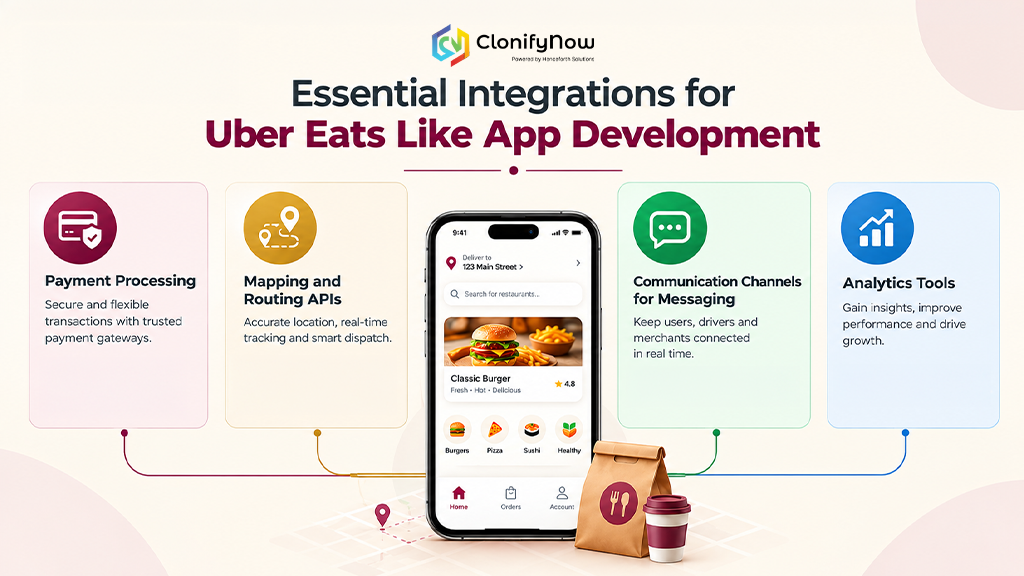
Contemporary delivery systems depend on third-party integration of payment processing systems, SMS gateways, mapping APIs, and transactional communication. Executing an Uber Eats-like app development roadmap requires balancing external API usage fees with strategic in-house development.
Payment processing: With payment gateways, like Stripe or BrainTree, for example, delivery services are able to split payments between various parties of the transaction, putting users’ funds into escrow until the food is successfully delivered.
Mapping and routing APIs: Using Google Maps to geocode the location and MapBox for visual routing means having to weigh the API licensing costs against the accuracy of navigation.
Communication channels for messaging: Utilizing Twilio or Firebase Cloud Messaging services, delivery services implement the use of automated SMS notifications, push notifications, and hidden VoIP calls to preserve the confidentiality of personal data.
Analytics tools: With the use of pipelines like Mixpanel or Google BigQuery services, integration takes place to analyze operational metrics, delivery time, and customer churn rate.
Cost Considerations and Scalability in Best Tech Stack for Food Delivery App
When assessing investments in technology, it’s important to weigh up the investment in initial development against the ongoing costs of hosting, API usage, and maintenance. Selecting the best tech stack for food delivery app deployment means factoring total cost of ownership into early architecture decisions.
Costs of Using Third-Party APIs: Mapping APIs and communication APIs are directly proportional to the order volume, and without caching, the API costs can cut up the net profit.
Availability of developers: When choosing a programming language, the more popular it is (like JavaScript and Python), the cheaper the hiring process.
Optimising cloud infrastructure: With auto-scaling worker nodes and using serverless functions during low-traffic times it is possible to avoid overprovisioning.
Refactoring and Technical Debts: In many cases saving on initial code architecture will lead to expensive rewrites of the code later.
Mitigating Operational Risks with a Robust Uber Eats Clone App Architecture
Creating a successful Uber Eats Clone app necessitates a proper approach to avoid system failures due to equipment issues, connectivity interruptions, and security breaches.
Security and Regulatory Requirements: API endpoints are made secure thanks to using OAuth 2.0 protocol, while PCI-DSS compliance for the payment process provides protection from security violations and fines.
Disaster Recovery and Failover: Distributed database replication means that there is a backup for the information that makes it easy to transfer the load somewhere else in case the primary database goes down.
Normal Performance Slowdown: The incorporation of circuit breakers saves the system from affecting the rest of the operations because of any issues with minor operations (for instance, the case when the app cannot show the proper route for the drivers).
Automated Diagnostics and Continuous Integration and Delivery: Conducting end-to-end integration testing before every update guarantees that no problems with the transactional system will be introduced.
Creating Your Platform Strategy for Sustainable Growth
The challenge of building an enterprise delivery platform for many companies lies in reaching the right equilibrium between the urgency of launch and the necessity of making the chosen technology sustainable. The technology architecture chosen today will determine a company’s operational reliability, hosting costs, and flexibility.
ClonifyNow Uber Eats Platform offers a reliable technology framework that enables a business to roll out its solution faster and enhance its growth.

Aman kumar
Aman is a Content Writer/Strategist with over 3 years of experience creating content that drives engagement, builds brand authority, and supports business growth. Having worked in both agency and in-house environments, he understands how to develop content strategies that align with business objectives while meeting audience needs.


