





The global on-demand transportation market is growing exponentially. For entrepreneurs, business owners, and enterprise decision-makers, there is a highly lucrative opportunity in this space. But a common architectural dilemma often throws a wrench in the launch: Build your own platform or buy an off-the-shelf clone solution?
To resolve the Uber clone app vs. custom taxi app debate, you have to look into your budget deeply, your long-term business goals, and your time-to-market constraints. If you choose the wrong development path, your company could face months of delays and waste thousands of dollars of capital.
Did You Know? The global ride-hailing and taxi market is projected to reach over $432 billion by 2028, growing at an annual rate of about 11.7%.
We’ll review this in-depth analysis to help you select the model that best aligns with your organization’s vision.
1. Analyzing the Uber Clone Taxi App Model
Choosing between a white label taxi app and custom development is not simply about software features. The detailed white label vs custom development comparison is a decision that affects how quickly you enter the market, how much capital you invest upfront, and how much flexibility you retain as your business grows. For startups, fleet operators, and enterprise mobility companies, the right choice depends on business stage, funding, and long-term objectives.
Time to Market
A white label taxi app can usually be branded, configured, and launched within a few weeks because the core infrastructure has already been developed and tested. Custom development requires product planning, UI/UX design, architecture, coding, testing, and deployment, which often extends the launch timeline to several months. If market timing is critical, a white label solution offers a significant advantage.
Development Cost
White label platforms require a much lower initial investment because the development cost is shared across multiple deployments. Custom development demands a substantially higher budget for design, engineering, quality assurance, and ongoing product management. Businesses with limited startup capital often choose white label solutions to reduce financial risk.
Feature Flexibility
White label applications include proven ride-hailing features such as rider booking, driver management, dispatch, payments, notifications, and admin controls. Custom development allows every workflow, interface, and integration to be designed around your specific business model, making it better suited for companies with unique operational requirements or enterprise-level processes.
Maintenance and Technical Support
With a white label platform, updates, bug fixes, security patches, and performance improvements are typically handled by the technology provider. In a custom-built platform, your business is responsible for maintaining the application, managing infrastructure, and funding future enhancements, which increases long-term operational complexity.
Scalability and Long-Term Growth
White label taxi apps are designed to scale across multiple cities and growing driver networks, making them suitable for most startup and regional expansion strategies. Custom development offers greater long-term flexibility for businesses that expect complex integrations, proprietary algorithms, advanced analytics, or specialised mobility services beyond standard ride-hailing operations.
2. Must Have Features in Uber Clone App Architectures
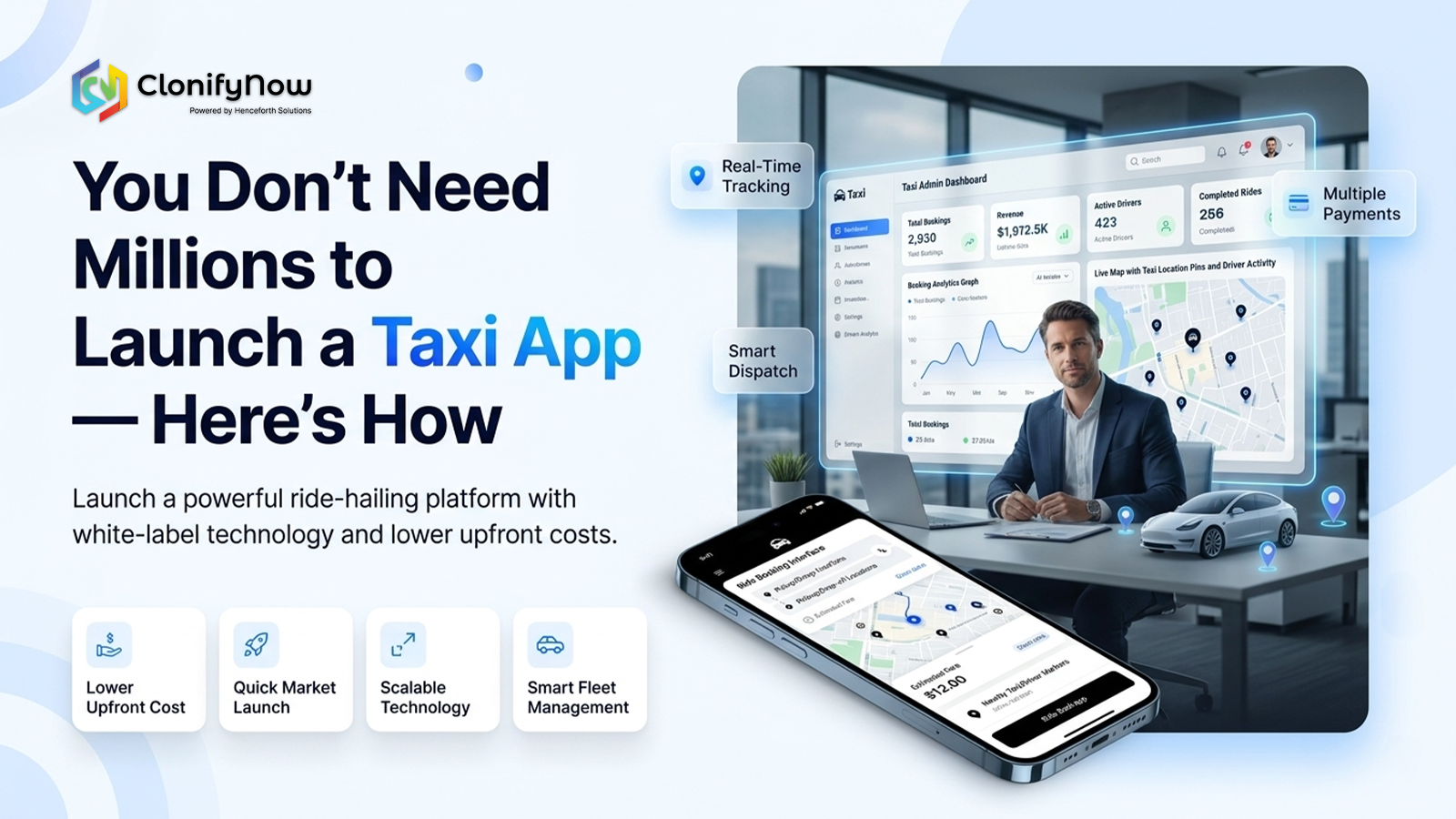
A ride-hailing system is a complex ecosystem. It needs 3 different yet interconnected interfaces to function: passenger app, driver app, and centralized administrator dashboard. To compete in today’s market, your software foundation needs to offer some essential features out of the box. These functionalities are incorporated right into the fundamental architecture to make sure you are up and running from day one with app development services company like ClonifyNow.
When analyzing your technical options, ensure that these Uber clone app frameworks have fully integrated the core taxi app features list.
Advanced Passenger Functionalities
- Real-Time GPS Location Tracking
To build user trust, you require accurate, low-latency car location sync with powerful map APIs.
- Auto fare estimate
Users stay because of the clear, transparent pricing methods that take into account distance, traffic conditions, and vehicle type.
- Payment Gateways, Multiple
Offerings including credit and debit cards, digital wallets, in-app wallets, and cash help optimize conversions.
High-Performance Driver Tools
- Smart Trip Alerts
Optimized dispatch algorithms assign ride requests to the closest available driver to reduce wait times.
- Intelligent In-App Navigation
Route optimization helps drivers to avoid traffic congestion and get the travel done faster by turning.
- Earnings Analytics Dashboard
Drivers are incentivized with transparent tracking measures for daily, weekly, and monthly income performance.
Centralized Admin Dashboard Controls
- Dynamic Price Spike
Fares can be changed automatically or manually at times of heavy demand, such as during rush hours or weather conditions.
- Complete User Management
Full control to easily approve driver credentials, customer accounts, and disputes.
When these must have features in Uber clone app packages are implemented properly, your platform gains the operational stability needed to handle high transaction volumes without structural failures.
3. Financial Breakdown for Evaluating the Uber Clone App Price
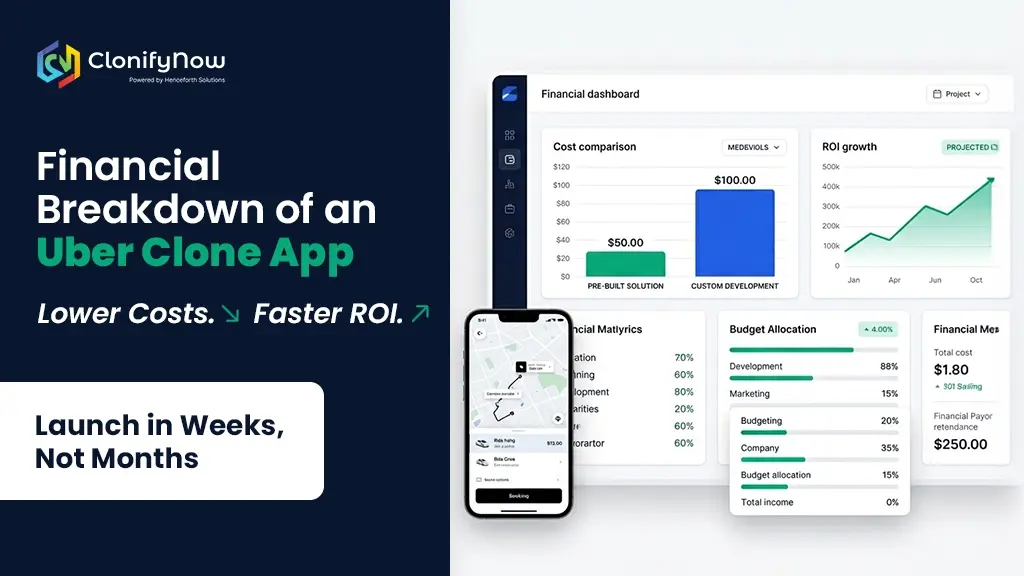
For startup founders and marketing leaders, the bottom line is the bottom line. Understanding the short-term and long-term financial implications of the Uber clone app vs. custom taxi app decision, including how these platforms generate revenue, is crucial for business viability. Pre-configured solutions require a fraction of the upfront investment needed for custom options. The Uber clone app price is very predictable as you are purchasing a foundational software package and are not paying for thousands of open-ended development hours.
| Expense Category | Pre-Configured Clone Solution | Custom Built Platform |
| Initial Upfront Development Cost | Low to Moderate | High / Enterprise Level |
| UI/UX Design & Prototyping | Included in Base Package | Expensive Custom Iterations |
| Quality Assurance & Testing | Pre-tested Core Engine | Extensive Alpha/Beta Sprints |
| Time to ROI Generation | Weeks | 6 to 12 Months |
This means you can keep the Uber clone app price low, and also frees up vital funds that can be reinvested directly into driver acquisition campaigns and localized marketing strategies. Providers like ClonifyNow specialize in providing such cost-effective, market-ready architectures so that businesses can own the solution without breaking the bank and still get high-quality software.
4. Developing a Custom Taxi App with Scalability and Control.
Clone apps are incredibly fast and financially beneficial, but some enterprises are working on a unique platform. Building your custom taxi app is a blank slate. Your development partner has to write every single line of code from scratch, from the initial database schemas to complex dispatch algorithms. This process involves extensive discovery workshops, UI/UX prototyping, sprint planning, and iterations of quality assurance testing.
Engineering Capital Intensity
Building a custom system from scratch requires a constant stream of capital. You are paying for a dedicated team of frontend engineers, backend developers, QA testers, and project managers for months. In addition, unexpected technical challenges while developing a custom taxi app can lead to budget overruns, putting your runway in doubt even before the application hits the app stores.
Infrastructure for long-term scalability
Whether you have a custom platform or a high-end clone script, you need architecture that can handle traffic from concurrent users. The best clone solutions are based on scalable cloud environments with reliable databases and microservices that scale organically with growing concurrent ride requests. However, the reason for selecting a custom taxi app is often a misconception of scalability and is not cost-effective at all. The modern pre-built taxi apps are capable of handling a high number of users.
5. Choosing a Platform between Uber Clone App vs. Custom Taxi App
To put an end to the Uber clone app vs. custom taxi app discussion, let’s analyze the best-fit use cases of each development style. A typical concern is that a ready-made system will drive your organization to become a generic, cookie-cutter brand. But modern systems are based upon relatively modular, white-label frameworks. This makes the implementation of custom elements easy without the excessive premium of custom development.
Tailoring Capabilities Within Pre-Built Frameworks
- Develop a Brand Customization
We insert your special logos, color schemes, and theme styles so your software will seem completely native.
- Feature Toggle (On-premises)
The option to enable/disable specific ride hailing categories like hourly rentals, outstation journeys, or bidded fare models.
- Compliance Integrations by Area
Flexible to adapt to local tax arrangements, multi-currency requirements, and regional language needs.
Ready to claim your share of the ride-hailing market?
In the end, the decision to go with an Uber clone app vs. custom taxi app depends on whether you want to spend your resources developing basic features that are already available,or invest that budget directly into market launch and user acquisition. It is also worth comparing your chosen approach against carpooling revenue models to see which monetization strategy fits your market best.
At ClonifyNow, we remove the guesswork from launching. We provide end-to-end white-label high-performance solutions for the ride hailing sector for start-ups and developing businesses. With our platforms, you get the price advantage of the Uber clone app plus the stability, premium features, and ongoing technical support your business needs to thrive.
FAQs about Uber Clone Taxi App
1. What is the difference between an Uber clone app and a customized cab app?
Uber clone app is a ready-made, ready-to-launch ride-hailing solution that can be easily customized and deployed. A custom taxi app is a tailor-made solution developed from scratch to satisfy unique business needs.
2. Uber Clone App Vs Custom Taxi App – Which Is More Expensive?
These Uber Clone apps are cheaper compared to developing a custom-designed taxi app from scratch. Hence, they are the most preferred solution for small enterprises and startups.
3. What is the cost of developing an Uber clone app in 2026?
Price varies based on features, customizations, and platform needs. But ready-made solutions are generally less expensive than designing a taxi app from the ground up.
4. What is the development time for an Uber clone app?
Most white-label Uber clone solutions may be adjusted and deployed within weeks, but specialized taxi apps usually take several months or up to a year to build.
5. Can an Uber clone app be customized according to my business needs?
Yes, modern solutions are branded, feature-adapted, payment-integrated, language-specified, and region-compliant.



 +91-9464826889