


In today’s mobility space, building a defensible platform demands balancing speedy time to market with rigorous risk management. Uber clone app development offers a capital-efficient roadmap for mobility innovators and enterprise operators but off-the-shelf software can’t ignore the single biggest operational liability: passenger and driver security. Safety is the dominant factor in global market studies of passenger retention and regulatory compliance.
And venture capitalists and institutional investors are increasingly demanding risk mitigation infrastructure during due diligence, making compliance and security non-negotiable underpinnings for sustainable unit economics. Not adhering to required security protocols diminishes trust in the platform, exposes regional operations to significant liability and eventually jeopardizes long-term valuation during funding rounds.
Strategic Advantages of Uber Clone App Development for Investors
When pitching venture firms or institutional syndicates, founders are often faced with a fundamental trade-off: build proprietary architecture from scratch or leverage white-label frameworks. Building a platform from scratch will take 12 to 18 months of heavy investment. In contrast, Uber clone app development drastically reduces launch times to a matter of weeks. Pre-built frameworks are viewed favorably by investors as they validate core unit economics (CAC, driver retention, net burn) without jeopardizing upfront capital on basic routing algorithms.
Leadership teams may utilize proven operational models to move early stage funding from low-level software plumbing directly into local market acquisition, regulatory licensing and critical risk mitigation modules. Founders can demonstrate quick time-to-traction on a stable baseline by providing clean operational metrics like lifetime value to customer acquisition cost (LTV: CAC) ratios and gross merchandise value (GMV) growth at the Series A pitch stage.
Core Rider Safety Features Essential for Enterprise Market Entry
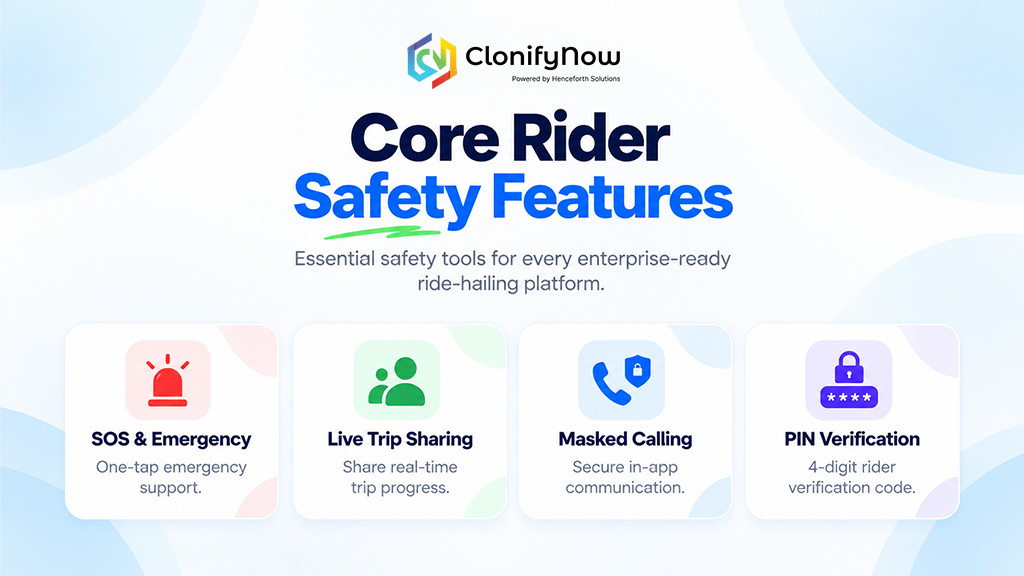
A resilient mobility solution needs a security infrastructure built in the passenger user experience. Modern platform governance is based on continuous verification, ongoing surveillance, and immediate incident response options to reduce operational risk.
Critical Security Capabilities:
In-App SOS & Emergency Assistance: One-tap emergency trigger that connects directly to local law enforcement dispatch centers and private security networks. The system automatically transmits live GPS telemetry, vehicle ID information and trip history to internal compliance teams.
Live Trip Sharing (Share My ETA): It uses real-time location tracking over secure WebSockets so riders can share their journey progress live with trusted contacts. It is available on mobile and web browsers and does not require any app download.
Number Anonymization and Encrypted Communication: Interoperable voice-over-IP (VoIP) and masked relay servers ensure that driver-rider communications are confidential and do not expose personal mobile numbers, thus protecting privacy and preventing off-platform harassment.
PIN verification to start the trip: A four digit security code generated on the rider interface that drivers must enter before starting the meter preventing riders from entering the wrong vehicle and eliminating driver impersonation risks.
Evaluating Platform Architecture for Ride-Hailing App Development
Deploying enterprise-grade ride-hailing app development strategies involves choosing between off-the-shelf modules and custom safety integrations. The comparison below outlines how key technical features impact platform governance, compliance, and long-term costs.
Safety Capability | Basic Off-the-Shelf Implementation | Advanced Enterprise Implementation | Strategic & Commercial Impact |
Driver Identity Verification | Basic manual document upload check | Automated biometrics, real-time facial scanning, and background checks | Prevents account sharing and reduces insurance liability claims. |
Telemetry & Anomaly Detection | Static route tracking via periodic GPS pings | AI-driven spatial tracking flagging unplanned stops or route deviations | Proactively identifies incidents before riders trigger an emergency signal. |
Driver Fatigue Management | Manual offline toggles | Automated online time caps with mandatory rest period locks | Meets municipal transport regulations and lowers accident rates. |
Audio/Video Recording Session | None | Encrypted in-app audio logging triggered during flagged disputes | Accelerates dispute resolution and deters fraudulent claims. |
Mitigating Risk in Taxi Booking App Development Projects
Enterprise taxi booking app development necessitates careful consideration of risk management, platform liability, and user friction. The safety measures should provide regulatory compliance while avoiding any delays in the onboarding process of drivers and impacting the booking experience of the riders.
Automated Biometric Identity Verification: Biometric verification by using the facial recognition scans before drivers start their shifts avoids any account sharing or vehicle misuse, thus protecting brand reputation.
Automated Route Deviation Detection: Machine learning algorithms detect route deviation, long periods of idle time, or abrupt dropping off and send an automatic safety alert from the centralized dispatching system.
Data Privacy Compliances: To adhere to the regional data privacy compliances such as GDPR in Europe or privacy laws in North America, telemetry data needs to be stored in an encrypted format along with the communication logs.
Insurance and Claim Processing: Building telemetry pipelines that record acceleration, speed, and braking information in real-time will help to ease the claim processing and bring down the commercial auto liability insurance costs.
Pitching Platform Security and Safety Features in an Uber Clone App to Investors
During fund raising rounds, investors consider scalability of the platform, risk exposure, and operational controls. Discuss safety features in an Uber clone app in terms of capabilities that enhance the performance of your business, and not just costs of maintenance. The three key operational metrics you should focus on when pitching your business to venture capitalist boards include:
Incident per Trip Ratio: Keep the targeted safety incident metrics below 0.001% of total number of trips made to ensure platform reliability and reduce operational buffer.
Driver Onboarding Cycle Time: Optimize background verification process for the drivers to reduce driver friction but also ensure compliance.
Customer Retention through Safety Capability: Measure the impact of your safety capability on customer retention rate to prove that increased trust increases customer lifetime value.
Partnering with an Uber Clone App Development Company for Scalable Growth
To build an enterprise-ready ride-hailing service, you need to choose an experienced uber clone app development company that strikes a balance between speed to market and robust technological architecture. The proper technology partner has to deliver modular software frameworks that can adjust to changing municipal legislation, local payment gateways and advanced telemetry equipment.
Organization leaders protect their balance sheet from operational liabilities by focusing on continuous driver screening, dynamic route tracking, and encrypted communication channels and set their organization up for long-term success.
If your organization is looking at platform choices, do a thorough technical examination of the regulations, safety requirements and scalable infrastructure of your target market before spending capital. Accelerate your launch timeframe with ClonifyNow. Schedule an architectural consultation and get business grade mobility solutions.

Aman kumar
Aman is a Content Writer/Strategist with over 3 years of experience creating content that drives engagement, builds brand authority, and supports business growth. Having worked in both agency and in-house environments, he understands how to develop content strategies that align with business objectives while meeting audience needs.


