





Building a software product from scratch is notoriously risky and expensive. The standard path for startup founders, business owners, and enterprise decision makers often involves months of delays, unpredictable engineering costs, and a high risk of building something the market doesn’t want.
Learn how to develop a clone app for your business and scale rapidly without burning through your capital. If you want to get a digital product out fast and to market quickly without the costly process of building it from scratch with code, ClonifyNow is the perfect solution.
Did you know? The global mobile app market is projected to reach $673 billion by 2027, creating massive opportunities for businesses launching clone apps and digital platforms.
This is the main reason clone apps have become a huge strategic advantage in the tech industry.
How to build a clone app for maximum ROI
When looking into how to build a clone app, the primary goal is maximizing your return on investment by capitalizing on validation that has already occurred. Market leaders have already invested millions of dollars in testing user behaviour, UI layouts, and feature viability. You create a clone app. You get that huge research phase for free.
To make this strategy a profitable reality, your development process needs to strike a balance between cost-saving efficiency and business-driven customization.
Market research and monetization strategy
Before you type one line of code, you need to figure out what your unique value proposition is. Look hard at the platform you are cloning, and find its weaknesses. Is it too expensive for the local vendors? Is their app too busy for the older demographic? These gaps are where you can tailor your version to a specific niche.
You’ll want to finalize your monetization framework next. Will you monetize your app with in-app ads, a percentage of transactions, premium subscription tiers, or a freemium model? As a result, a crystal clear revenue strategy ensures the application is built to capture profit from day one.
Tech stack selection and infrastructure
The long-term maintenance cost and scalability depend on the underlying technology chosen. If your goal is to minimize your expenses, then cross-platform frameworks like Flutter or React Native are highly recommended as they allow you to deploy a single codebase on both iOS and Android platforms simultaneously.
You want to use a secure cloud infrastructure like AWS or Google Cloud for the backend so you can handle traffic spikes without crashing. Using ready-to-go API integrations for core utilities like Stripe for payments or Twilio for SMS notifications will also save hundreds of hours in development.
UI and UX customization
The core architecture is the same as an existing application, but the user interface has to look and feel completely different. Partner with product designers to create a unique brand identity, color palette + iconography.
What you want to do when you figure out how to build a clone app is to keep the intuitive, familiar user experience that people already love, while providing a new, unique brand environment that builds trust with your specific target audience.
Clone app development steps for a smooth launch
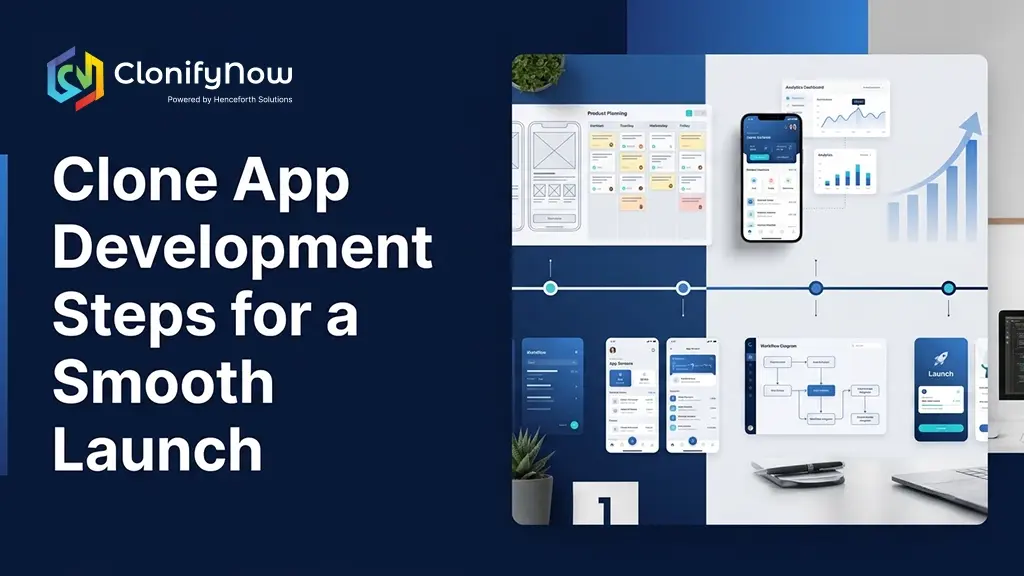
You need a clear roadmap to run your project efficiently. By going through the clone app development steps, you keep your engineering team on the same page, avoid scope creep, and make sure you don’t spend resources on features you don’t need during the first launch stage.
There are four distinct phases in the development of an idea from concept to live product.
Scope and MVP definition
The first important step in all clone app development steps is to define your Minimum Viable Product (MVP). An MVP includes only the essential features required to solve the main problem of the user and handle transactions.
For instance, if you are making a food delivery app clone, your MVP needs a restaurant listing, a shopping cart, a payment gateway, and basic order tracking. Fancy features like AI-based meal recommendations or multi-stop delivery can wait until you have active users and actual revenue.
Core architecture and coding
With your MVP scope locked in, the dev team can start building out the frontend and backend systems. Engineers don’t have to reinvent the wheel with new database schemas, thanks to preconfigured app architectures built for clone apps.
Using tried and tested development frameworks, you can realise rapid deployment, from wireframing to a fully functional beta application in a fraction of the time it would take with standard custom development cycles.
Quality assurance and security testing
One thing you can never afford to cut corners on is testing. Your quality assurance team must run stringent functional testing, usability testing and cross-device compatibility checks to assure a seamless user experience.
You should also perform deep security audits and vulnerability scans. Your app will likely deal with sensitive personal information and financial transactions, so you need to check robust encryption protocols and secure database access before you launch.
Deployment and maintenance
Once the product passes all the quality checks, it is time to submit the application to the Apple App Store and Google Play Store. It’s a matter of following the strict developer guidelines and optimization rules, or it will be rejected.
Once it’s launched, your focus shifts to monitoring system performance, analyzing user feedback, and rolling out regular updates to fix bugs and improve stability as your active user base starts to grow.
Clone app development guide to reduce expenses
To launch your product successfully without overspending, you need a practical clone app development guide to focus on cost containment. “It’s not about compromising quality; it’s about working smarter and getting rid of redundant tasks.”
Businesses can reduce their overall tech spend by as much as 60 percent through strategic asset reuse and smart resource allocation.
Leverage pre-built white-label solutions
The highest cost in traditional software engineering is writing boilerplate code from scratch. You can save hundreds of thousands of dollars right off the bat by using a white-label alternative or an established clone framework. When you team up with a specialized group offering app development services like ClonifyNow, you receive solid, pre-tested software infrastructures that are totally adaptable to meet your specific business objectives.
Focus on open source libraries
Why pay for proprietary software licensing when there are high-quality open source alternatives? By leveraging trusted open-source libraries for features such as chat interfaces, data charts, and data caching, you can drastically reduce third-party operational dependencies. This reduces your initial building costs and your monthly software overhead in the long run.
Implement agile project management
Miscommunication and changing requirements are the main causes of budget overruns. Agile project management involves breaking the development cycle into short, two-week iterations known as sprints. There is a working piece of software at the end of each sprint. This constant feedback loop catches mistakes early, checks features incrementally, and keeps the project budget strictly under control.
Technical architecture and database design
Your technical stack should be scalable to allow your system to function seamlessly even with heavy traffic. Understanding how to develop a clone app requires focusing heavily on database optimization and clean code structure.
Database optimization strategies

- Database Sharding: Break your database infrastructure into smaller, faster, and more manageable pieces called shards to avoid single-point bottlenecks during high-traffic times.
- Data Caching: Store frequently accessed data in an in-memory caching system, such as Redis. This minimizes the load on your primary database and enhances your app’s response times.
- Indexing Fields: Make sure that all the primary search filters, user IDs, and transaction records are properly indexed so that the queries fire up in a flash.
API framework and third-party integrations
Modern applications rely on seamless communication between different software systems. A modular API architecture enables your app to efficiently talk to outside services. This enables features like automated geolocation, instant messaging, and multi-currency payment processing, without you having to build those complex systems yourself.
Marketing and post-launch scaling
Launching your software is just the beginning. The key to building a sustainable, high-growth business is to generate user acquisition and keep those users.
App store optimization tactics
If you want to boost organic downloads without spending a fortune on paid marketing, then you have to improve your store listings. Do good keyword research by using high-volume search terms in your title and description; create enticing pictures that show off your main features; and encourage early users to post positive five-star ratings and thorough reviews.
Customer retention and loyalty loops
- Push Notifications: Initiate targeted push notification campaigns to re-engage users with abandoned carts, special discounts, or local activity.
- Loyalty Programs: Reward your highly active, dedicated community of repeat customers with points, access, or cash-back incentives.
- In-App Feedback Tools: Add easy, no-hassle feedback forms directly into your product so users can report bugs or suggest new features to your product team.
Making the final strategic decision
A lot of the successful modern tech company landscape looks like companies taking an existing model and improving it. Following a practical clone app development guide, you can systematically remove the financial roadblocks that hold back most innovators, bringing a polished, high-performing product to market at a fraction of the cost.
Now that you know how to develop a clone app and navigate the clone app development steps successfully, you can make an informed choice for your business infrastructure. Are you ready to cut production costs, speed up your launch timeline, and partner with a team that knows how to scale digital products efficiently? Contact ClonifyNow today and turn your vision into a high-growth reality.
FAQs on How to Develop a Clone App
Is clone app development legal for startups and businesses?
Yes, clone app development is legal when you replicate business models and features without copying copyrighted code, trademarks, branding, or proprietary intellectual property.
How much will it cost to build a clone app in 2026?
The cost of developing a clone app depends on the features, platform, and customization needs, but businesses usually spend much less than developing a completely custom application.
Why is Clone App Development the First Choice for Founders Over Custom Software?
Founders love clone apps because they mitigate development risk, speed up time-to-market, reduce costs, and capitalize on existing business models with inherent demand.
Which industries use clone app development services the most?
Clone app solutions are often used by food delivery, ride-hailing, grocery delivery, logistics, healthcare, and marketplace businesses to launch scalable digital platforms faster.
How to Earn Money Successfully from a Clone App?
Companies can monetize their platforms through commissions, subscriptions, advertising, premium features, transaction fees, and partnerships, depending on their target market.



 +91-9464826889