





There’s a massive movement going on in the digital health space. Consumers today don’t want dull workout videos or stagnant PDFs. They want sophisticated, deeply tailored, and hyper-connected digital experiences. Custom fitness app development is no longer a luxury for organizations wishing to enter this market but a growth lever.
Did you know? The global fitness apps market was valued at $12.12 billion in 2025 and is projected to reach $33.58 billion by 2033, growing at a 13.4% CAGR.
This guide from ClonifyNow strips away the technical language and shows you exactly how to handle market realities, product requirements, and the strategic development phases needed in establishing a competitive fitness platform in 2026.
1. Choosing the Right Fitness App Development Services for Your Business
Developing a successful digital product requires more than engineers to write code. It requires a partner with cross-platform architecture, safe data management, and engagement mechanics. With the correct Fitness App Development services, your application will scale easily from the first launch to servicing hundreds of thousands of concurrent users.
The detailed development involvement is organised around key high-value pillars:
- Discovery & Product Strategy: We begin with user persona design, defining the fundamental value proposition and the technological architecture – all before a single line of code is written.
- Product Design UI/UX: Building modern, high-retention interfaces based on human psychology, making sophisticated data tracking intuitive and frictionless.
- Engineering & Cloud Infrastructure: Developing safe, compliant, and resilient backend systems that enable real-time data processing and provide the backbone of strong front-end interfaces.
- Post-Launch Optimization: Iterative enhancements based on the analytics of user behavior, security patches, and updates to the operating system.
2. Setting Up Technical Frameworks and Fitness Coaching Software
Modern applications should function as ecosystems rather than standalone tools. Companies are integrating specialist fitness coaching software into their mobile platforms to provide genuine value. This creates a two-sided marketplace or platform where trainers can manage clients, assign routines, and track visible progress indicators asynchronously.
To keep your software competitive, a basic technical architecture has to serve three major pillars:
A. Seamless Wearable Integrations
Your platform must effortlessly capture biometric data. For this, there are native integrations with main hardware systems:
- Apple HealthKit & Google Health Connect: Gives you consolidated access to sleep cycles, heart rate variability (HRV), and step counts.
- Proprietary API Integrations: Integration with specialized hardware like Garmin, Whoop, and Oura Ring to provide power users with deeper, continuous insights into their physical recovery.
B. High-Performance Video Infrastructure
Latency and streaming quality can make or break the user experience in providing live or on-demand content:
- Content Delivery Networks (CDNs): Using edge servers placed throughout the world to quickly deliver global video content without buffering.
- Adaptive Bitrate Streaming (ABR): Changing the video quality according to the user’s available network bandwidth in real-time, so as not to interrupt the stream.
C. Advanced Analytics Engine
The backend has to do more than just store numbers; it has to synthesize them into actionable insights.
- Automated Progress Tracking: View training volume, strength milestones, and historical calorie balances over time.
- Predictive Retention Metrics: Identify users with below baseline engagement, allowing for automatic push notifications or coach interventions before user churn.
3. How to Develop a Fitness App Safely and Efficiently
Turning a product idea into a market-ready application is a complex undertaking. Building fitness software is a balancing act between getting to market quickly and keeping the code maintainable over time. A chaotic delivery process risks running out of cash before you achieve product-market fit.
This is the precise operating system that successful product teams use to design and ship stable, healthy platforms:
Step 1: Architecture and technical scope validation
Before development starts, cross-functional teams should agree on the technological stack and systemic needs. This involves selecting native languages (Swift and Kotlin) or cross-platform frameworks (Flutter or React Native) to maximize your development timeline and engineering budget.
Step 2: High Fidelity UI/UX Prototyping
Designers sketch out the whole experience, concentrating on less friction during onboarding. High-fidelity prototypes will be tested for usability to verify that the navigation paths are fully self-explanatory.
Step 3: Feature Engineering Kernel
Developers construct the application via iterative sprints. The core is developing bulletproof user authentication pipelines, robust database schemas, and core tracking engines.
Step 4: Stringent Quality Assurance and Security Audits
Fitness platforms manage sensitive, personal metrics of users. Testing must involve full security vulnerability assessments, load testing to replicate peak usage times, and cross-device functioning verification.
4. Calculating the Cost of Developing a Fitness App
Budgeting for enterprise-grade digital products requires analyzing multiple cost drivers. The overall cost of developing a fitness app varies widely depending on your structural scope, architectural complexity, and regional engineering rates.
| App Complexity Tier | Estimated Cost (USD) | Primary Technical Focus |
| Starter Plan | $49/month | Standard templates, simple profile creation, basic workout logging, manual entry features. |
| Growth Plan | $99/month | Wearable integrations, video streaming, customized fitness coaching software portals, localized multi-language setups. |
| Scale Plan | $249/month | Advanced data analytics, real-time synchronous video, complex cross-platform setups, highest-tier security. |
Major Financial Drivers
Understanding where your capital is spent enables better allocation across the development lifecycle:
- Platform Strategy- Building a single cross-platform codebase is often 30-40% less expensive than building fully distinct native apps for both iOS and Android at the same time.
- Recurring monthly running costs are generated by video hosting pipelines (e.g., Mux, Twilio), advanced analytics platforms (e.g., Mixpanel), and cloud storage services.
- Security compliance requirements- While implementing end-to-end data encryption technologies will entail some upfront engineering expense, it will save millions in possible liabilities and data breaches.
5. Strategic Monetization Frameworks for Maximum ROI
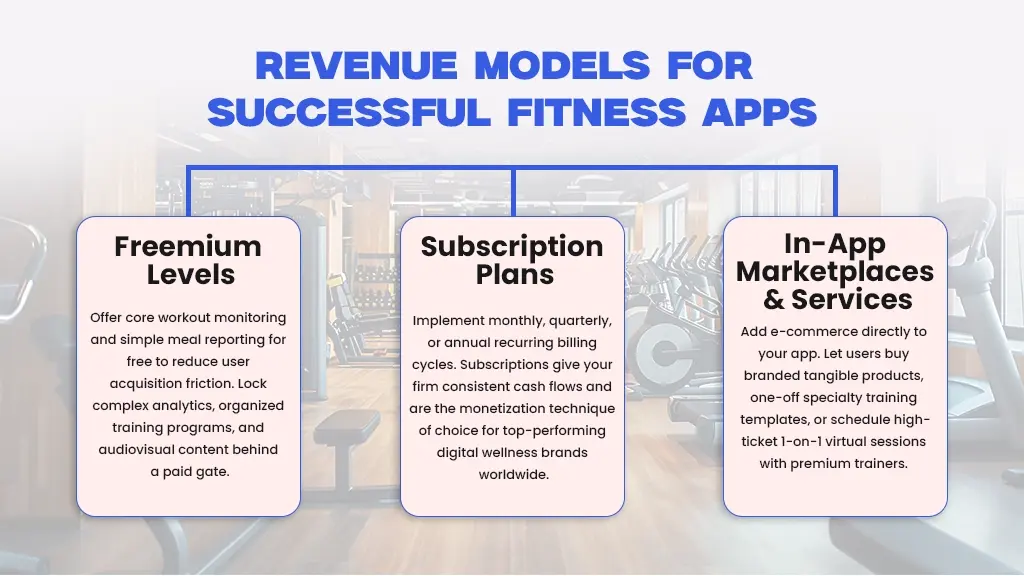
Launching your platform is only half the battle; it needs to be built to produce sustainable commercial revenue. The right monetization strategy at the early cycle of fitness app development strongly affects the prioritization and design of your software features.
Freemium Levels
Offer core workout monitoring and simple meal reporting for free to reduce user acquisition friction. Lock complex analytics, organized training programs, and audiovisual content behind a paid gate.
Subscription Plans
Implement monthly, quarterly, or annual recurring billing cycles. Subscriptions give your firm consistent cash flows and are the monetization technique of choice for top-performing digital wellness brands worldwide.
In-App Marketplaces & Services
Add e-commerce directly to your app. Let users buy branded tangible products, one-off specialty training templates, or schedule high-ticket 1-on-1 virtual sessions with premium trainers.
Scale Your Vision with Custom Fitness App Development
The digital health business is moving fast. If you hold back on your digital product strategy, you may give up crucial market share to more agile competitors. Success demands a purposeful blend of intuitive UI design, solid data architecture, and a keen grasp of user retention mechanisms.
At ClonifyNow, we provide comprehensive fitness app development services as per your exact business goals. Whether you want to implement an ultra-specialized corporate wellness platform or expand a worldwide coach-led consumer app, our production team has the technical know-how to construct your platform clean, secure, and on budget.

FAQs About Fitness App Development
1. What will AI mean for the future generation of fitness apps in 2026?
Now fitness firms are using AI to give adaptive training plans, recovery tips, retention prediction, and personalized coaching that all contribute towards improving engagement, subscription renewals, and customer lifetime value.
2. What features should firms add when creating a fitness app?
As such, building the most competitive fitness solutions now requires capabilities like wearable integrations, real-time statistics, tailored coaching, video content distribution, and subscription management.
3. Why Wearable Integrations Are Important For Fitness Coaching Software?
Today’s customers anticipate seamless syncing with wearables and health gadgets so that coaches may provide data-driven recommendations based on activity, recuperation, sleep and performance data.
4. What are the primary factors influencing the cost of a fitness app development?
It depends on the AI functionality, wearable integrations, video infrastructure, platform choices, compliance requirements, and the number of personalization features, which drive the cost of development.
5. How Fitness Apps Drive Retention After Launch?
Successful solutions combine individualized coaching, behavioral analytics, automated engagement campaigns, and progress tracking to minimize churn and optimize long-term customer retention.


 +91-9464826889