




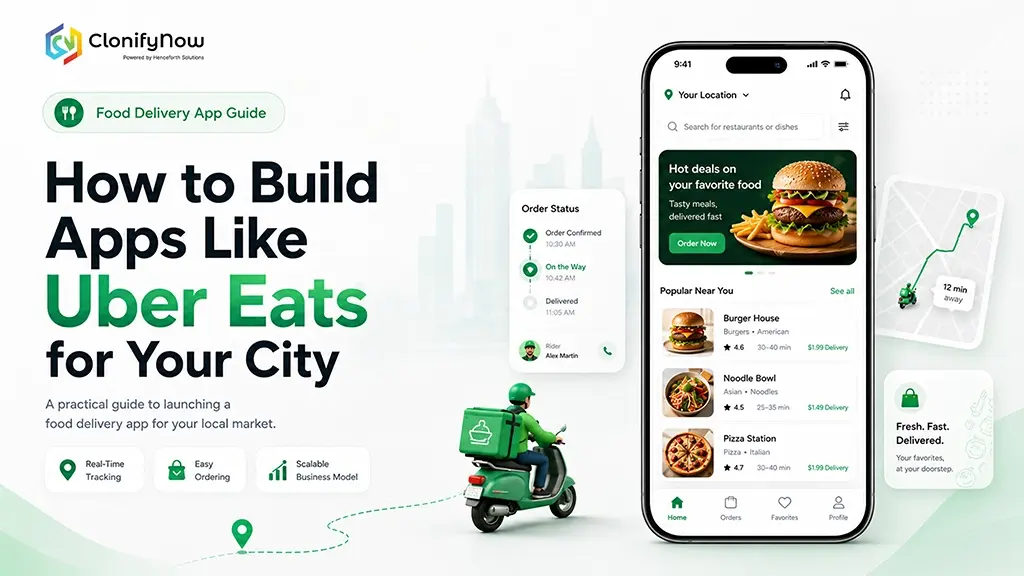
Launching apps like Uber Eats for your city is one of the smartest ways to enter the fast-growing food delivery market. A local delivery platform gives you control over your brand, your service area, your restaurant partners, and the customer experience. Instead of competing nationally from day one, you can build a focused city-based business that is easier to manage, quicker to launch, and more practical to scale. Did You Know? The global online food delivery market was valued at nearly $289 billion in 2024 and is projected to cross $500 billion by 2030, driven by smartphone adoption, faster delivery expectations, and growing demand for convenience. If you want to create a successful business in this space, the best strategy is to build around a clear city-first model and launch with a solution that supports real operations from the start. ClonifyNow helps businesses move in that direction with a practical, market-ready foundation. In this guide, we will walk through how to plan, build, and launch a city-focused food delivery platform in a way that feels simple, strong, and commercially smart.
Why do apps like Uber Eats work so well in local markets?
Local food delivery platforms succeed because they solve a daily need simply. People want food delivered quickly, restaurants want more orders, and riders want a system that keeps their work organized. That is exactly why apps like Uber Eats perform well in city-based markets. They connect all three sides of the business in one place and make ordering feel easy for everyone. A city-first approach also gives you better control over operations. You can choose your delivery zones carefully, partner with restaurants that already have demand, and keep your logistics tight during early growth. This makes it easier to launch, test, and improve the platform without dealing with the complexity of a large-scale rollout. This is also why the Uber Eats clone app is the best for your business. becomes an important question. The answer lies in speed, practicality, and market familiarity. A clone-based solution helps you enter the market faster because the core structure already follows a proven food delivery model. Instead of spending months figuring out the basics, you can focus on branding, restaurant onboarding, and customer acquisition.
- Start with one city and one clear service area.
- Choose restaurants with steady local demand.
- Keep delivery routes short and efficient.
Build a simple ordering experience that customers can trust.
How to develop a tremendous food delivery app?
The answer starts with choosing the right features. A strong food delivery platform should not try to do everything at once. It should solve the most important problems first: ordering, delivery tracking, restaurant coordination, and business control. This is also where the question of how the Uber Eats clone app works? becomes easy to understand. A modern app usually includes four connected parts: a customer app, a restaurant panel, a delivery partner app, and an admin dashboard. These parts work together to keep the system smooth and organized. Customers place orders, restaurants accept and prepare them, riders deliver the food, and admins monitor the entire flow from one place. Uber Eats clone app development becomes valuable because it gives you a practical base for customer, restaurant, rider, and admin workflows. A customer browses restaurants, adds items to the cart, places an order, and tracks progress in real time. The restaurant receives the request, prepares the food, and marks it ready. The rider is assigned, picks up the order, and completes the delivery. That full process is what makes the platform efficient and commercially valuable.
- Customer app for browsing menus, placing orders, and tracking delivery.
- Restaurant dashboard for managing menus, pricing, and order status.
- Rider app for accepting trips, navigation, and delivery updates.
- Admin panel for commissions, reports, support, and business control.
ClonifyNow focuses on this kind of practical structure because it helps businesses launch with confidence instead of confusion.
What Does the Cost to Develop an Uber Eats Clone Depend On?
The cost depends on several factors, including the number of features, the design approach, the level of customization, and the type of launch model you choose. If you build from scratch, the investment is usually higher because you need separate work for product planning, UI and UX design, development, testing, and deployment. A ready-made or white-label solution usually brings the cost to develop Uber Eats clone down because the core structure is already built. This can be a smarter option for startups that want to launch quickly, test the market, and avoid long development cycles. Your final budget may also change based on whether you want customer app features only or a full platform with restaurant, rider, and admin panels.
- More features usually increase development effort.
- Custom design adds to the overall budget.
- White-label solutions can reduce launch time.
- A full marketplace platform costs more than a basic ordering app.
Ready to launch your city delivery brand?
Building apps like Uber Eats for your city is really about building a business that people can rely on every day. The strongest platforms are not the most complicated ones. They are the ones that help customers order quickly, help restaurants manage demand smoothly, and help business owners grow with control. If you want to enter the food delivery market, starting with one city is a smart and practical strategy. It gives you a chance to test demand, improve operations, and create a strong brand presence before you expand. A well-planned app can become the base for a long-term delivery business if it is designed around speed, trust, and local relevance. ClonifyNow can help you take that next step with a solution built for business growth. If your goal is to launch fast and build something that works in the real world, the right foundation can make all the difference.
FAQs about apps like Uber Eats
1. What are apps like food delivery?
Apps like Uber Eats are food delivery platforms that let customers browse restaurants, place orders, and track deliveries in real time from one app.
2. How do food delivery apps work?
These apps connect customers, restaurants, delivery partners, and admins in one system. A customer places an order, the restaurant accepts it, and a rider delivers it to the door.
3. How much does it cost to build a delivery platform?
The cost depends on features, design, app complexity, and whether you choose custom development or a ready-made solution. A white-label option is usually faster to launch.
4. What features should apps like Uber Eats have?
The most important features include restaurant search, menu browsing, order tracking, secure payments, rider updates, and an admin dashboard.
5. Why do businesses build apps like Uber Eats?
Businesses build these apps to launch a food delivery service. Reach more customers, support local restaurants, and create a scalable online marketplace.

 +91-9464826889