





Times have changed, and so have the ways businesses operate. Now, companies look for instant solutions. They don’t want technologies that take years to develop and decades to launch. They seek ready-made solutions that can be quickly launched, scaled, and customized. If you, like most modern businesses, are looking for a fast and cost-effective way to launch your business idea, what you need is a clone app.
Don’t worry if you don’t know anything about a clone app. We will help you know everything about it, inside and out. A clone app is a replica of popular apps, such as Uber or Zomato. But wait! Here is a twist. Though a clone app is built on a ready-made foundation, the bottom line is that businesses can customize it according to their needs. Got the point? No, it’s okay. We have curated this blog to help you out. Keep on reading this blog to learn about clone apps in detail.
What is a clone app?
So, what is a clone app? Think of it as a readymade launchpad that is inspired by popular apps such as Uber, Talabat, TaskRabbit, Tinder, or any well-known app. It has the same structure and may have the same search option as Uber or Zomato, but businesses can customize it.
After getting an idea of what a clone app is. The next thing that might come to your mind is how exactly it works. Should you consider launching with a clone app? What is a clone app used for? Don’t worry; below is the answer to all your questions.
How Does the Clone App Work? Step-by-Step Guide for Businesses
A clone app uses a pre-built framework to connect users, service providers/vendors, and administrators in real time. So, it is not just a mobile app. In fact, it is a complete digital infrastructure that handles everything from user requests to service delivery and data management.
When a user places a request, the system instantly processes it, matches it with the right provider, and ensures service completion. This entire flow is fast, automated, scalable, and secure, which is why modern businesses prefer investing in a clone app development company instead of building complex systems from scratch.
What Is the Structure of a Clone App?
A modern clone app is built as a complete digital platform, where every part of the business, from customers and service providers to admins, functions together in real time. The structured architecture of clone apps ensures smooth coordination, rapid performance, secure data handling, and full operational control.
Core components of a modern clone app system
- Customer App: The customer app helps users browse services, place requests, make payments, track live services, and share feedback.
- Service Provider App: The service provider app helps drivers, delivery partners, or service agents receive requests, manage schedules, accept jobs, and navigate in real time.
- Admin Panel: The admin panel gives complete control of the platform to business owners. Through the admin panel, they can manage users, providers, services, and pricing.
What Are the Structural Differences Between Clone Apps and Custom Apps?
Building a custom app from scratch can feel like navigating uncharted waters. It’s expensive, time-consuming, and full of uncertainties. Long development cycles can lead to delays, technical glitches, and unexpected budget overruns.
In contrast, an Uber like clone app uses digital frameworks that are already tested in real markets. This makes them faster to launch and more reliable. They reduce risk, speed up market entry, and let brands focus on growth instead of technical complexity. So, a cloned app alternative, such as a custom app, may not always be a viable choice.
- Custom apps
- High development and infrastructure costs
- Long timelines before launch
- Higher technical and business risk
- Complex testing and debugging cycles
- Slower updates and difficult scaling
- Clone apps
- Built on proven, tested structures
- Faster development and quicker launch
- Lower investment risk
- Cost-effective implementation
- Easy scalability for future growth
- Smooth upgrades and feature expansion
How Clone Apps Expand from Single to Multi-Service
Clone apps are not restricted to a single service model. They are designed to evolve, expand, and scale with business growth. What often starts as one focused service can gradually transform into a complete multi-service digital system.
This flexibility allows businesses to add new verticals, introduce new revenue streams, and adapt to changing market demands without rebuilding the entire platform. Instead of launching multiple separate apps, companies can grow everything within one unified system, creating a stronger brand presence, better user retention, and a future-ready digital infrastructure.
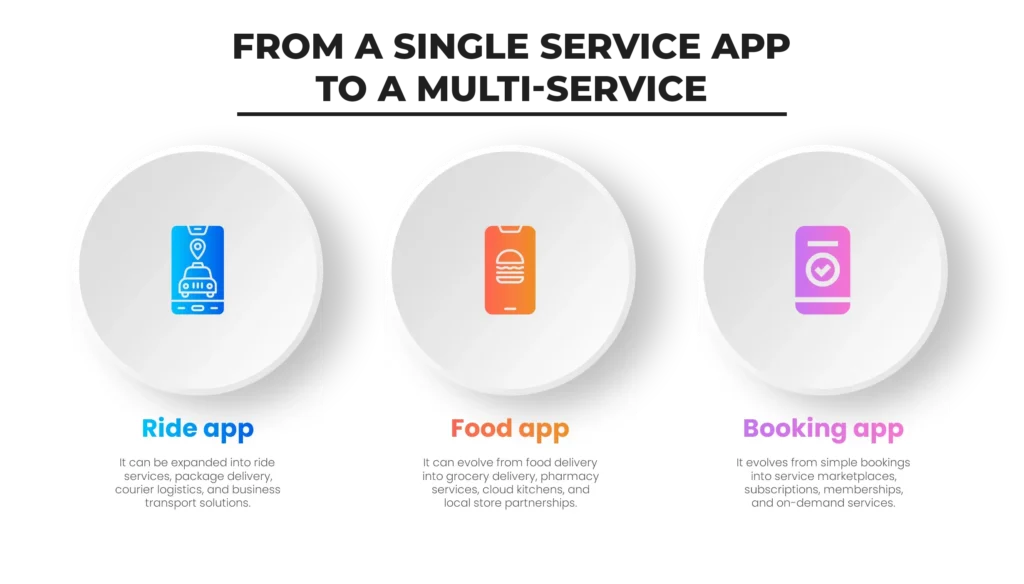
From a single service app to a multi-service platform
- Ride app: Ride apps can be expanded into package delivery, courier logistics, and business transport solutions.
- Food app: Food apps can evolve from food delivery into grocery delivery, pharmacy services, cloud kitchens, and local store partnerships.
- Booking app: Booking apps can evolve from simple bookings into service marketplaces, subscriptions, memberships, and on-demand services.
What Are the Key Use Cases of Clone Apps?
Clone apps can be adapted to almost any industry. They are not limited to one type of service. Instead, they cater to a wide range of industries. From startups to established companies, clone apps enable brands to quickly launch digital platforms. They don’t need to start from scratch, which reduces development costs and time and also ensures scalability. Many businesses have successfully implemented clone apps to serve their customers efficiently, expand their offerings, and scale operations with ease.
Popular Use Cases of Clone Apps
Transportation
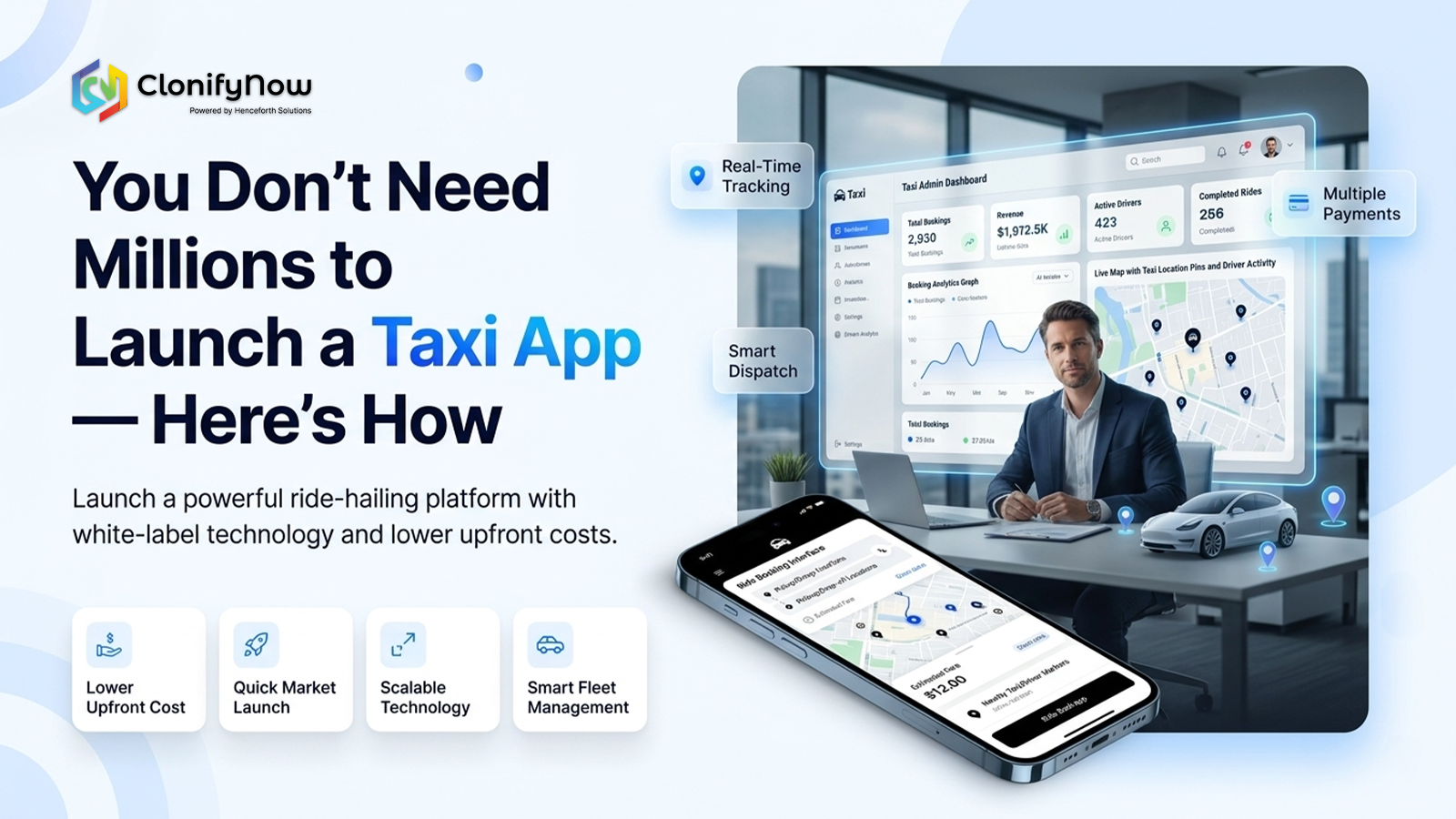
An Uber clone app is one of the most common use cases of clone apps. Some other examples are taxi booking apps and logistics services.
Food Delivery
Platforms such as restaurants, cloud kitchens, and multi-restaurant delivery platforms, which are often built as a white-label food delivery app, are another use case of clone apps.
Logistics and E-commerce
Logistics apps include delivery apps and on-demand shipping services. Similarly, online stores, marketplaces, and multi-vendor platforms are a few e-commerce use cases.
Home Services and Tourism
Home service apps, such as cleaning, plumbing, repairs, and maintenance services, are widely adopted and cloned use cases. Likewise, travel booking platforms, tour guide apps, and experience-based service platforms are common examples within the tourism sector.
Future of Clone Apps
Today’s businesses aren’t satisfied with apps that simply perform a task; they demand platforms that anticipate, learn, and grow alongside their users. Modern clone apps are evolving into digital ecosystems. They are smart, interconnected, and dynamic.
From automating complex operations to analyzing behavior patterns, Clone App transforms data into actionable insights, making it a future-ready engine that caters to businesses, users, or any stakeholder involved.
FAQs
1. What is a clone app?
A clone app is a digital platform that uses a proven business model framework to develop an app. They offer similar core functionalities, but they can be customized with unique branding, features, elements, functionality, and integration based on a business’s needs.
2. What is the purpose of a clone app?
The purpose of a clone app is to help businesses launch fast with a well-known business model. They don’t need to experiment with an entirely new model. Instead, they use the same proven framework and customize it according to their needs.
3. Why would someone want to clone an app?
Businesses use clone apps because they allow them to launch faster and enter the market with a proven app model. Unlike custom apps, which take months of research, design, development, and testing, clone apps launch instantly and are cost-effective.
4. Is it possible to detect a clone app?
Clone apps use the same business logic and workflow, but they don’t use the same source code. Furthermore, they are customized with unique branding, features, elements, and integrations according to the business requirements.
5. Can companies build an uber like clone app?
Yes, development companies such as ClonifyNow can build an Uber-like clone app. They can deliver all the functionalities of Uber, such as real-time tracking, secure payments, automated fare calculation, and more.

 +91-9464826889