





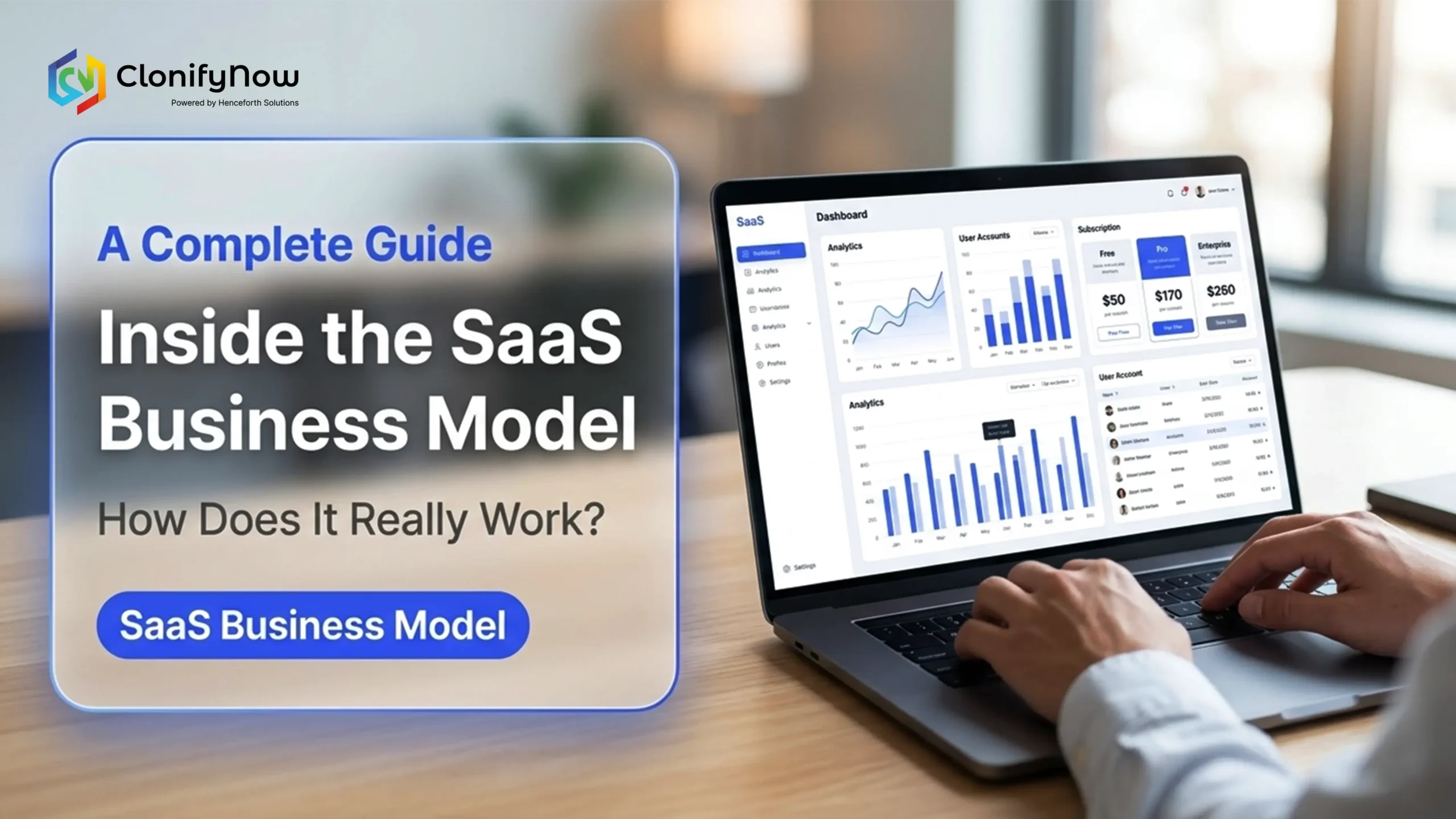
Have you ever wondered what business models popular platforms such as Google Workspace, HubSpot, and even Netflix follow? Well, they operate on a SaaS business model. Do you know what a SaaS business model is? No, relax; we will help you know. A SaaS (Software as a Service) business model delivers software on a subscription basis. So, instead of a one-time purchase, businesses earn recurring revenue. This model comes in different forms, depending upon how companies choose to structure their pricing and value delivery. Companies choose different SaaS pricing models, such as usage-based, tiered, and more, to meet the needs of diverse customers and to gain profits. Simply put, SaaS business models such as cloud-based gym management software are totally different from how traditional product companies operate. In the article, we’ll go in-depth on what the SaaS business model is, how to build it, and more. So, buckle up for an exciting journey.
What is a SaaS business model?
SaaS business model pricing refers to the way in which software companies charge users for accessing their cloud-based services. There are broadly six types of SaaS business model pricing that most enterprises use.
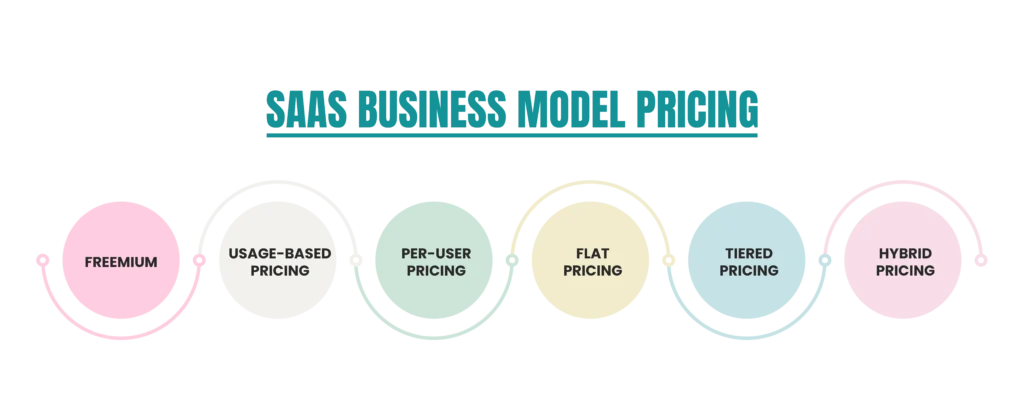
Freemium
In this type of pricing, businesses provide users access to the basic features of the software for free. Let us take an example to understand this model. In Canva (a photo and video editor tool), users can edit photos and videos using basic tools and features for free. But to access advanced tools, users need to subscribe to their plans.
Usage-based pricing
In usage-based pricing, businesses enable users to pay on a usage basis. This model is popular because it lets users pay for what they use. One of the most common examples of a usage-based pricing model is Uber. In Uber, you pay only for the ride you book according to distance, time, and demand. Uber does not charge you for using their platform or making searches.
Per-user pricing
Per-user pricing enables businesses to charge customers based on the number of users who are accessing their software. Zoom is a wonderful example of this model in which the license is priced per user. For example, if the platform charges $6 for a user and a company has 10 employees, then they have to pay $60 per month.
Flat pricing
With this pricing model, customers have to pay a set price either monthly or annually to get complete access to the software. Apps like Netflix and Spotify enable users to pay a one-time fee and get unlimited access to their software.
Tiered pricing
Tiered pricing is a model in which a business offers multiple tiers or plans with different features, limitations, and benefits. Users can choose the plan based on their requirements and budget. For example, Slack, which is a team collaboration tool, provides free, Pro, and business+ plans. Their free plans have limited features, whereas their higher-tier plans provide more features.
Hybrid pricing
In this model, businesses combine two or more Saas models, which helps companies provide customized pricing to customers. Many software companies use hybrid pricing models, such as Zoom, which uses both per-user pricing as well as tiered pricing (basic, pro, and business plans that offer different features).
How to build a saas business model
Before jumping into how to build SaaS business models, you first need to understand who your target audience is, the problem your software resolves, and the values it offers. These questions will determine the success of your Saas software. Here is a step-by-step process of how you should start building a SaaS business model.
Define your problem and niche
Start with a clear, specific problem that your target audiences are facing, such as an SME’s struggle to track online grocery delivery. You can provide the solutions by providing a SaaS-based grocery management app that lets them manage orders, track deliveries, and more.
Choose pricing and packaging
Next is to segment your customers and design pricing tiers for them with clear features. You can start with simple, predictable pricing, such as per month or per user, which makes it easy for them to scale.
Build product and technical foundation
Start by solving the core problems, such as tracking grocery orders daily, and then launch as soon as possible. You can use a cloud-native stack, such as AWS or similar, and design a system that is scalable and provides easy scaling.
Distribution and go to market
Decide on channels that suit your product and help you grow. There are basically two channels through which you can promote and market your product.
a.) Product-Led Growth
In this strategy, the product itself brings in users.
- Users sign up directly on their own (no salesperson needed)
- They may get a free trial or a free version.
- The app is designed so users can easily understand and start using it.
- Example: You try a SaaS tool, explore it, and then upgrade if you like it.
b.) Sales-Led Growth
Here, a sales team helps bring in customers.
- Businesses directly contact potential customers.
- They explain the product and close deals.
- Often used for expensive or enterprise-level SaaS products.
- Includes partnerships and targeted outreach.
Also, you can make a clear landing page, create use-case content, and use lead capture funnels such as email, LinkedIn, and more.
Acquire and retain customers
You can offer free trials or freemium plans to attract customers and make them experience your app’s core functionality. During this time, you should focus on customer retention and provide regular feature updates to keep users engaged.
Track Key Saas metrics
Tracking key SaaS metrics will help you know how well your platform is performing. Some of the most important metrics that will help you measure your growth and profitability are MRR (Monthly Recurring Revenue) and ARR (Annual Recurring Revenue), CAC (Customer Acquisition Cost) and LTV (Lifetime Value), churn rate (how many users you are losing), and activation rate (how many users complete key actions).
Don’t worry if you are not familiar with these metrics. We will explain each of these in our next blog.
Final thoughts
So, this is what a SaaS business model is all about. We know there are many more things to explore and understand in SaaS. Understanding key SaaS metrics is one of them. In our next blog, we will explore the SaaS metrics in detail and make you familiar with many more aspects of Saas. This will help you decide whether SaaS is the right choice for you.
FAQs
1. Is the SaaS business model different from traditional software?
Yes. In the SaaS model, customers subscribe to get access to the software. In traditional software, customers purchase it permanently. So, the focus shifts from one-time purchases to recurring revenue and long-lasting relationships.
2. Why is customer retention important in a SaaS business model?
Customer retention is important because the SaaS model relies on subscriptions. Losing customers means reducing recurring revenue, which makes customer retention vital for growth and profitability.
3. How do SaaS companies determine the pricing models?
Companies determine the pricing model by analyzing their target audiences, the value their product is offering, and what pricing models competitors are following. Sometimes other factors, such as customer needs and usage patterns, are also considered.
4. Does the SaaS model support global scalability?
Yes, SaaS software is hosted in the cloud, which users can access from anywhere. Companies don’t need to make significant investments in infrastructure for a particular region, which means they can scale their user base more easily.
5. What metrics should companies track to measure their performance?
Companies should track metrics such as Monthly Recurring Revenue (MRR), Annual Recurring Revenue (ARR), customer churn rate, and more.




 +91-9464826889