





The way people access services today has entirely changed. Whether it is booking a ride, ordering food, or scheduling a home service, users now expect everything to happen instantly. This growing demand for speed and convenience is driving the rapid rise of on demand services across industries. From food delivery to healthcare and mobility, more businesses are shifting towards real-time, app-based solutions to meet customer expectations.
Many businesses still rely on outdated systems and manual bookings, which leads to slow service, poor customer experience, and inefficiencies that affect growth. While some companies are investing in mobile apps and automation, others are still struggling without a clear digital strategy. This is where on demand apps make a real difference. In this guide, we will explain how they work and how you can build one that solves real problems and supports long-term business growth.
Understand the Problem: Why Do Traditional Business Models Fail Today?
Before you think about building on demand apps, you need to be very clear about one thing: what problems your current business model is actually facing. Most businesses don’t decide to go digital because it sounds good. They do it because their daily operations are becoming harder to manage. When orders start coming through different channels, there is no way to determine which ones are missed, delayed, or duplicated, which leads to confusion and inefficiencies.
On-demand apps solve these issues by bringing everything into one streamlined system: bookings, tracking, communication, and payments. Instead of reacting to problems after they happen, businesses can manage operations proactively, improve efficiency, and deliver a much better customer experience.
The Solution: What is an On Demand App & how does it work?
Once you clearly understand the problems in your current system, the next step is to look at the solution, what an on-demand app actually does, and how it improves your business operations.
An on-demand app is designed to connect users with service providers in real time. Instead of managing bookings manually or relying on disconnected tools, everything happens inside one unified system. From placing a request to completing the service and processing payments, the entire journey is streamlined and automated.
In simple terms, the process looks like this:
User request → System matching → Service delivery → Payment → Feedback
These apps are widely used across industries like ride booking, food delivery, home services, and healthcare because they focus on speed, convenience, and transparency.
How Do On Demand Apps Work?
The table below breaks down the core flow of an on demand app and explains what happens at each stage:
Step | What Happens | Why It Matters |
User Request | The user opens the app, selects a service, and sends a request | Starts the service process instantly |
Smart Matching | The system finds the nearest or most suitable provider | Reduces waiting time and improves efficiency |
Service Acceptance | The provider accepts the request | Confirms service availability |
Service Execution | Service begins with real-time tracking | Keeps both the user and the business informed |
Payment Processing | The user completes payment through the app | Ensures secure and smooth transactions |
Feedback & Rating | User shares reviews and ratings | Helps improve service quality |
Core Modules of On Demand Apps
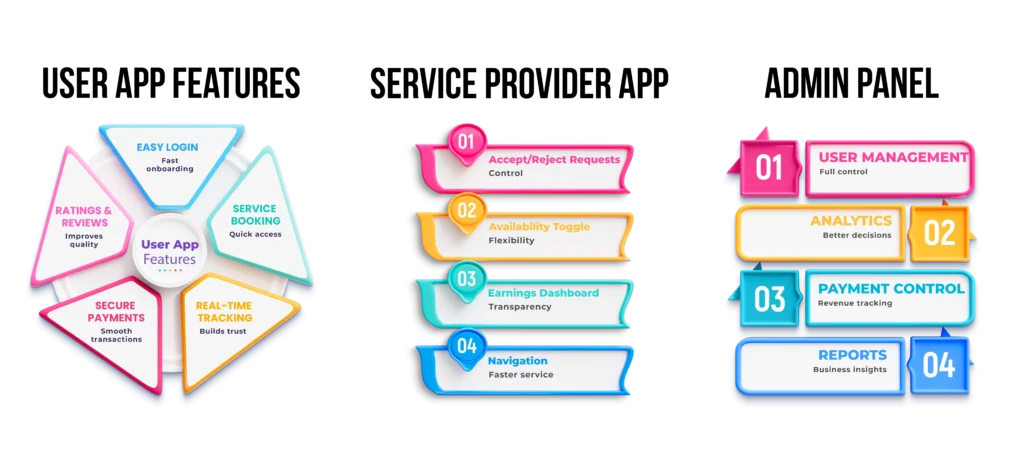
On-demand apps typically consist of three modules or parts: a user app, a service provider, and an admin panel. Here is how these components work together to create a seamless on-demand ecosystem:
- User App: Enables easy booking, secure payments, real-time tracking, and a smooth user experience.
- Service Provider Panel: Helps providers manage requests, availability, navigation, and earnings efficiently.
- Admin Panel: Offers full control with user management, analytics, payment tracking, and business reports
How to Build an On Demand App Step by Step
This roadmap explains how an on demand app is actually planned and built in the real world. You don’t need to be technical to understand it; each step focuses on business decisions, not coding.
1. Define Goals & Requirements
Before you start building your app, you need to be very clear about what you want to achieve.
Start by identifying your business goals. Are you trying to provide faster services? Improve customer experience? Increase bookings? Or scale your business without increasing operational costs? These goals will guide every decision you make during development.
Next, define the problems your app should solve. For example:
- delayed service requests
- poor communication with customers
- lack of real-time tracking
- inefficient manual processes
Now, understand your users and what they expect from the app.
User | What They Need From the App |
Customers | Easy booking and real-time updates |
Service Providers | Simple task management and navigation |
Admin | Full control, analytics, and reporting |
When your goals, problems, and users are clearly defined, the development process becomes much more focused and efficient.
2. Choose Your Business Model
At this stage, you need to decide how your app will operate in the market. There are different models you can choose from depending on your business type:
Model | What It Means | Example |
B2C | Businesses serve customers directly | Food delivery apps |
B2B | Businesses serve other businesses | Logistics platforms |
P2P | Users interact directly with each other | Rental or sharing apps |
Choosing the right model helps you define your features, revenue strategy, and user experience.
3. Choose Your Technology Stack
This step decides how your app will function behind the scenes. You don’t need deep technical knowledge, but understanding the basics helps you make better decisions.
Layer | Purpose | Tools |
Frontend | What users see and interact with | Flutter, React Native |
Backend | Handles business logic and operations | Node.js, Django |
Database | Stores all app data | MongoDB, Firebase |
Payments | Processes transactions | Razorpay, Stripe |
When choosing your tech stack, ask:
- Can it handle future growth?
- Is it secure and reliable?
- Can it integrate with other tools?
A good tech stack ensures your app works smoothly today and scales easily tomorrow.
4. UI/UX Design Principles
This step is about how your app feels to use. Even a powerful app will fail if it’s difficult to use.
The most important rule is simple:
Every screen should clearly guide the user on what to do next.
Research shows that around 75% of users judge an app’s trustworthiness based on its design, so simplicity and clarity are critical.
Different users have different needs:
User | What They Care About Most |
Customers | Fast booking and smooth experience |
Service Providers | Easy navigation and task handling |
Admin | Clear dashboards and insights |
Good design reduces confusion, improves engagement, and increases retention.
5. Development & Integration Approach
Now comes the actual building phase. At this point, you decide how your app will be developed.
There are three main approaches:
Option | What It Means | When It Works Best | Limitation |
Custom Build | The app is built from scratch | Unique business needs | Higher cost & time |
Ready-Made Solution | Pre-built app | Quick launch | Limited customization |
Low-Code | Built using visual tools | Faster development | Limited advanced features |
In simple terms:
- Need speed → Ready-made
- Need uniqueness → Custom
- Need balance → Low-code
There is no one-size-fits-all solution. The best choice depends on your goals and budget.
6. Testing & Quality Assurance
Testing is one of the most important steps in the development process. No matter how well your app is built, real users will always find issues. Testing helps you identify and fix these problems early.
Here are the key areas to test:
Area | What It Checks | Why It Matters |
Performance | App speed and responsiveness | Prevents crashes |
Functionality | Features working properly | Ensures smooth usage |
User Flow | Ease of completing tasks | Improves experience |
Edge Cases | Unusual scenarios | Prevents unexpected errors |
Testing should not be limited to the end but should be continuous throughout development.
7. Launch & Continuous Improvement
Launching your app is just the beginning. A smart launch strategy starts with a small group of users. This helps you identify real-world issues and fix them before a full rollout.
On-demand businesses evolve quickly. New services, new users, and new expectations mean your app must keep improving. The most successful apps are not one-time projects; they are continuously evolving systems.

Cost & Time Estimates for On Demand App Development
One of the first questions every business asks is, “How much will it cost to build an on-demand app, and how long will it take?”
The honest answer is it depends. The cost and timeline vary based on what you want your app to do, how complex your idea is, and how quickly you want to launch. But you can get a clear estimate by understanding the key factors involved.
What Affects the Cost
The cost of building an on-demand app is mainly influenced by
- Number of features: More features mean more development effort.
- App complexity: Basic apps cost less than advanced, feature-rich platforms.
- Platform choice: Android, iOS, or both.
- Integrations: Payment gateways, GPS, APIs, third-party tools.
- Team location: Development costs vary by region.
A simple app with basic booking and payment features will cost much less than a fully advanced platform with real-time tracking, analytics, and multi-service support.
What Affects the Timeline
The time required to build your app depends on similar factors:
- Project size and complexity
- Clarity of requirements
- Number of features and user roles
- Integration with external systems
The more clear and focused your requirements are, the faster the development process will be.
Why On Demand Apps Are Essential for Modern Businesses
On demand apps have become a core part of how modern businesses operate. Customers today expect instant access to services, whether it’s food delivery, ride booking, or home services, all within a few taps.
In simple terms, on-demand apps connect users with services in real time, helping businesses deliver faster, operate efficiently, and stay competitive in a digital-first world.
Here’s how on demand apps create real value for businesses:
Area | How It Helps | Business Impact |
Faster Service | Enables instant booking and quick service delivery | Improves customer satisfaction and reduces waiting time |
Better Customer Experience | Offers real-time tracking, easy payments, and smooth UX | Builds trust and increases repeat users |
Automation | Automates bookings, payments, and notifications | Reduces manual work and operational costs |
Scalability | Easily handles growing users and demand | Supports business expansion without major changes |
Revenue Growth | Multiple monetization models like subscriptions & commissions | Increases overall business profitability |
Emerging Trends in On Demand Apps
On demand apps are evolving rapidly with new technologies and user expectations shaping the future.
Trend | What It Means | Business Impact |
AI Integration | Apps use AI for smart recommendations and automation | Improves efficiency and personalization |
Hyperlocal Services | Focus on nearby services. providers for faster delivery | Reduces delivery time and boosts local engagement |
Real-Time Personalization | Custom content and offers based on user behavior | Increases user engagement and conversions |
Subscription Models | Monthly/annual plans for regular users | Creates steady and predictable revenue |
Challenges in On Demand App Development
While on demand apps offer many benefits, businesses also face some real challenges.
Challenge | Problem | Solution |
High Competition | The market is crowded with similar apps | Focus on unique features and niche targeting |
User Retention | Users switch apps quickly | Improve UX, loyalty programs, and personalization |
Development Cost | Initial investment can be high | Start with MVP and scale gradually |
Tech Complexity | Requires real-time systems and integrations | Work with experienced development teams |
Conclusion
On demand apps are no longer just a digital trend; they have become a fundamental part of how modern businesses operate and grow. They are not simply about offering instant services but about transforming the way businesses manage operations, serve customers, and scale in a competitive market.
When implemented with the right strategy, on-demand apps help streamline daily processes, reduce manual effort, and eliminate operational bottlenecks. They improve overall efficiency, enhance customer experience through faster and more convenient services, and create new opportunities for revenue generation.
If you are planning to launch or upgrade your on-demand app, the focus should be on creating a solution that aligns with your business goals and user expectations. Because in today’s fast-moving digital landscape, the right on-demand app doesn’t just support your business; it becomes the foundation for sustainable growth.
FAQs
1. What is an on demand app?
An on demand app is a platform that allows users to request and receive services instantly whenever they need them. It connects customers with service providers in real time, enabling effortless booking, quick service delivery, and seamless payments.
2. Which industries benefit most from on demand apps?
An on demand app can benefit multiple industries by automating operations and offering fast, convenient services to customers. It helps businesses streamline processes, improve communication, and enhance the overall user experience.
3. How much time does it take to make an on demand app?
An on demand app typically depends on the complexity of features and level of customization. A basic app with essential features can be developed faster, while advanced apps may take more time.
4. What are the different types of on demand apps?
An on demand apps help businesses deliver services instantly to users whenever they need them. They come in various types, such as ride-hailing apps, food delivery apps, grocery delivery apps, healthcare apps, home service apps, and e-learning apps.
5. What features should an on demand app have?
An on demand app can include features like easy user registration, real-time tracking, secure payment options, push notifications, and an intuitive interface. These features help streamline processes, improve user engagement, and enhance the overall customer experience.
6. What types of apps can be built with on demand app development?
An on demand app can be used to build a wide range of applications across different industries. From food delivery and ride-hailing to healthcare, fitness, home services, and e-commerce apps, it helps businesses provide instant services to customers.
7. How do I choose the right On Demand App Development Company?
An on demand app development company can benefit you by turning your business idea into a scalable and user-friendly digital solution. It helps you choose the right technology, ensures smooth app performance, and delivers features that meet customer expectations.




 +91-9464826889