





So, you have the idea and even the industry that you want to enter, but you don’t know where to begin. Clone apps have emerged as a reliable and cost-effective solution for startups. But many founders don’t know how to make a clone app. Is it good to invest in building a clone app and more? Well, the good news is that clone app development is not as complex as many think it to be. But it’s also not what most people assume. In this blog, we will help you know everything about clone apps, how to make one, and more.
How to make a clone app?
We know you want to get the answer to this inevitable question: how to make a clone app. But before this, you first need to understand: what is a clone app? How do they work? How can it help you launch your business? What does the clone app do, and more? These questions will help you know whether you should go with clone apps or another developmental approach. A clone app, as the name suggests, is a platform that is a replica of a successful platform, such as Uber. Its essential features are already built, so there is no need to develop from scratch. But what does a clone app do? The answer to this question is in the next section in detail. We like breaking down things step by step, so you will have full clarity.
What does the clone app do?
Practically, a clone app does the following things. It helps you:
- Set up a fully functional app with essential features that are already built.
- Connect users and service providers on a single platform.
- Manage bookings, tasks, or transactions efficiently.
- Enable secure payments and smooth communication.
- Customize the app according to your business needs.
Understanding this is the first step in learning how to make clone app strategies work effectively.
Why Choose a Startup Using Clone Apps?
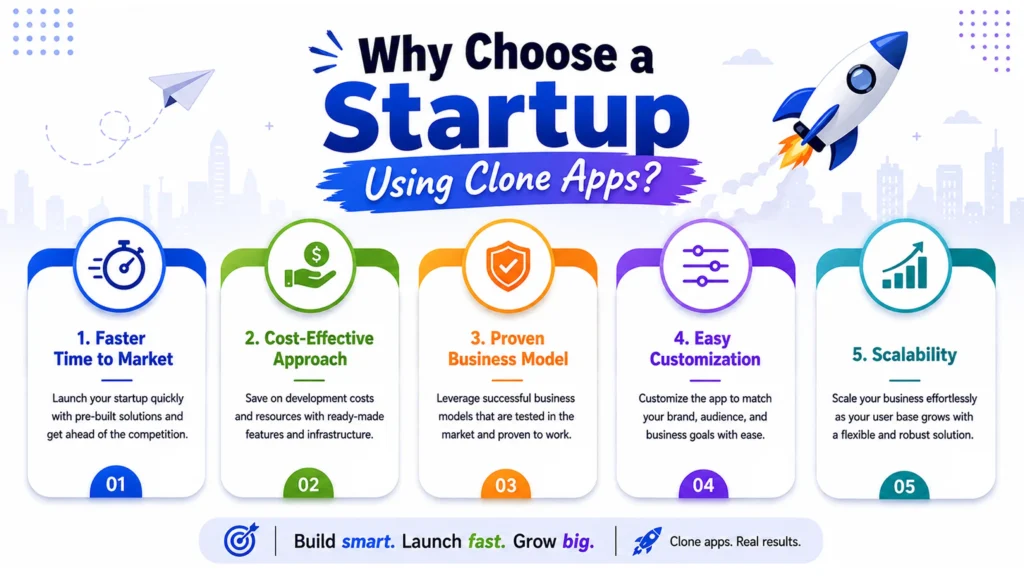
Cloning is not copying. It is building on something that has already worked for businesses. So, it provides a less risky path for launching your own platform. In other words, you are using a proven concept but customized it according to your business needs. Here are some key advantages of clone apps that make them a smart choice for startups.
Faster Time to Market
Speed is key when it comes to launching an app. Clone apps allow you to launch in weeks instead of months.
Cost-Effective Approach
Clone apps are not developed from scratch. This makes them perfect for startups that are looking for cost-effective development solutions.
Proven Business Model
Clone apps are made from successful platforms, which means they are already tested in the market and accepted by people. This lowers the risk of launching a new product and increases the chances of success.
Easy Customization
Most app development companies offer white-label solutions, which means they customize the app according to the business requirements.
Scalability
Clone apps can be easily scaled. This means businesses do not need to worry about app performance if the number of users or providers increases.
Step-by-Step Guide: Steps to Launch a Startup
Now that you have a clear idea about clone apps, the next step is to know how you can launch a startup using clone apps.
Step 1: Define Your Idea
Look for a problem to solve and identify the target market.
Step 2: Conduct Market Research
Analyze what your competitors are doing and discover the needs of the users. This will inform you on how to efficiently build your startup using clone apps.
Step 3: Choose the Right Clone Solution
Selecting the right platform and how you build the clone app for your needs is by far the biggest decision you have to make. So, consider your business goals, target audience, required features, scalability needs, and long-term growth potential before making a final choice.
Step 4: Customize Your App
Tailor the app according to your needs, like
- Change the features
- Add logos and graphic design.
- Create and customize the payment process.
- Enhance the workflow for users
Step 5: Define Your Revenue Model
Decide how you want your app to earn money:
- Take a cut on each transaction.
- Earn money from subscriptions.
- Charge service fees on platform usage.
- Generate revenue from advertisements.
Step 6: Test the App
In order to provide the best service possible, you need to make sure of the following:
- Navigation works as planned.
- The payment system functions properly.
- You have fixed all known bugs and optimized everything.
Step 7: Launch Your Startup
Implement the minimum viable product for your startup, perform a soft launch, and adjust everything based on the feedback.
Step 8: Spread the Word
To promote your startup, invest in local campaigns, social media advertisements, and referral programs.
Step 9: Scale and Improve
Develop and enhance your offerings based on feedback. However, while you are learning, try to avoid skipping market research, copying without adding value, overcomplicating the app in the initial stages, etc.
Final Thoughts
Launching a startup doesn’t mean building an app from scratch. By understanding how clone apps work, you can save time, cut down costs, and focus on your business growth. Using a clone app to start your business will give you the perfect opportunity to build your business with a tried and tested idea and, when combined with the correct guidelines, will allow you to develop this into a sustainable business. If you are creating your own app business, then a clone app to implement your idea is a great starting point.
FAQs
1. What does a clone app do for a startup?
A clone app can reduce your startup launch time by providing you with a pre-built, scalable platform. You can test your business ideas without investing in a new product, lowering risks.
2. Can I build a unique brand with a clone app?
Absolutely. Even though the base is inspired by an existing platform, you can fully customize the design, features, and user experience to create a strong and distinct brand identity.
3. What industries can benefit from clone apps?
Clone apps are widely used across industries like home services, food delivery, ride-hailing, freelance marketplaces, logistics, and more.
4. Do clone apps support future upgrades and new features?
Yes, most clone apps are built on scalable architecture, which allows you to add new features, upgrade existing ones, and expand your platform as your business grows.
5. Is technical knowledge required to manage a clone app?
No, most clone apps come with an easy-to-use admin panel that allows you to manage users, services, and payments without deep technical knowledge.


 +91-9464826889