


Targeting the food delivery market requires balancing rapid time-to-market with enterprise-grade platform architecture. For founders and product strategists, deploying an Uber Eats clone app offers a compelling path to market entry, combining proven product-market fit with predictable unit economics. Rather than re-engineering core logistics protocols, leveraging pre-built infrastructure allows ventures to allocate capital toward restaurant supply acquisition, driver network liquidity, and localized user growth.
However, long-term valuation depends heavily on feature selection and infrastructure design. This operational checklist outlines the non-negotiable features, technological architecture, and strategic investor considerations necessary to build, pitch, and scale a competitive food delivery platform in today's high-demand market.
Why VCs Prefer an Uber Eats Clone App over Custom Builds
When evaluating early-stage delivery platforms, venture capitalists scrutinize time-to-traction, capital efficiency, and customer acquisition costs (CAC). A ground-up custom build often requires 9 to 12 months of core development before processing a single live order, burning precious pre-seed capital on commodity features like authentication, cart management, and payment gateway bindings. Partnering with an experienced Uber Eats clone app development company compresses this launch window down to weeks, enabling immediate operational validation.
From an investor perspective, clone-based deployment shifts equity capital from baseline engineering to growth levers:
Proven Product-Market Fit: Investors view the underlying mechanics, three-sided marketplace interactions, real-time dispatch, and dynamic pricing, as validated industry standards, drastically reducing execution risk.
Capital Efficiency & CAC Recovery: Reallocating technical overhead to driver onboarding incentives and restaurant partner acquisition shortens the timeline to achieving regional density and order volume.
Unit Economic Validation: Pre-built frameworks allow founders to immediately test take-rates, delivery fee tiers, and subscription models to prove contribution margin positivity at the pitch stage.
Metrics That Drive Valuation: During Seed and Series A rounds, investors prioritize Monthly Active Users (MAU), Order Frequency, Average Order Value (AOV), Net Retention Rate, and Fleet Utilization Rates over proprietary source code complexity.
Core Food Delivery App Features for Customers to Drive Retention and AOV
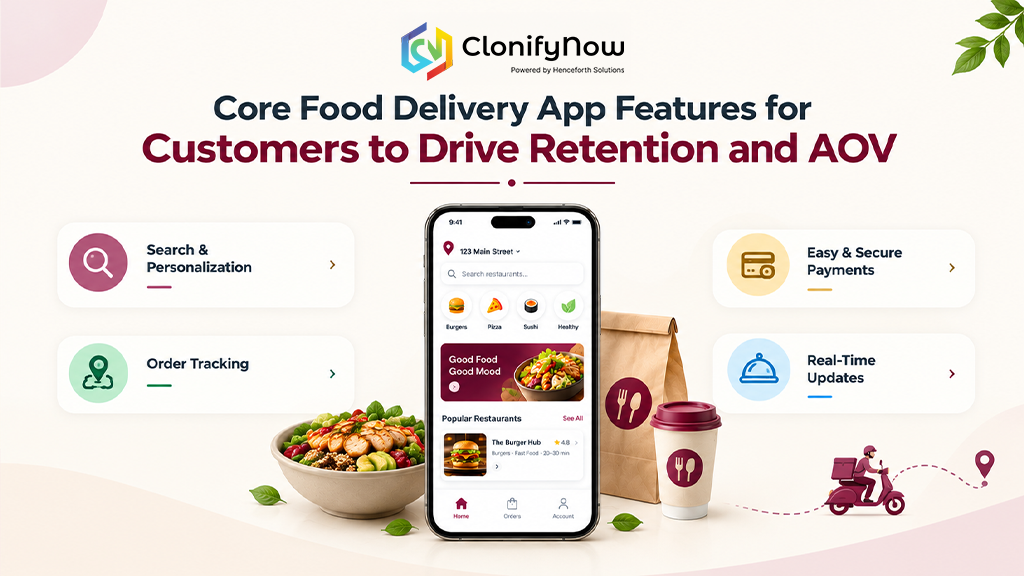
User experience directly governs conversion rates and repeat order cadence. Implementing robust food delivery app features for customers ensures frictionless discovery, checkout efficiency, and real-time operational transparency.
Intelligent Search, Personalization, and Dynamic Checkout
Multi-Tiered Filtering: Enables search by dietary restrictions, prep time, price points, vendor ratings, and real-time distance matrix algorithms.
Predictive Re-Ordering: Uses machine learning models to analyze past ordering schedules, surfacing favorite meals at peak dining hours to maximize conversion rates.
Dynamic Fee Transparency: Breaks down item costs, delivery surcharges, surge pricing, distance fees, and taxes upfront to minimize cart abandonment.
Real-Time Order Lifecycle Tracking
GPS Telemetry Integration: Maps order milestones from kitchen acceptance and food prep to driver dispatch, pickup, and doorstep arrival.
In-App Communication Gateway: Masked VOIP and SMS capabilities allow direct customer-driver updates without compromising user privacy.
Multi-Gateway Payment Processing: Supports credit/debit cards, digital wallets, bank transfers, and local payment methods with automated failover routing.
Essential Food Delivery App Features for Restaurants to Optimize Operations
Merchant retention hinges on system reliability and operational efficiency. Deploying targeted food delivery app features for restaurants reduces kitchen prep bottlenecks, minimizes order errors, and provides actionable business intelligence.
Merchant Capability | Technical Implementation | Direct Business Impact |
Kitchen Display System (KDS) | Dedicated merchant app or POS tablet middleware | Reduces prep order errors by up to 25% and eliminates paper ticket delays during peak hours. |
Dynamic Menu Management | Real-time database sync via API endpoints | Allows instant status updates for out-of-stock items, adjusting prep times and item variations dynamically. |
Automated Dispatch Coordination | Algorithmic driver matching based on preparation timers | Prevents hot food from cooling on counters while reducing driver wait times at restaurant locations. |
Merchant Analytics Dashboard | Real-time revenue, order volume, and cancellation metrics | Provides clear visibility into high-margin items, peak ordering windows, and operational bottlenecks. |
Critical Driver Fleet and Administrative Management Infrastructure
Sustaining fleet liquidity requires robust logistics tooling that optimizes route efficiency and earnings predictability for delivery partners.
Algorithmic Dispatch Engine: Automatically assigns orders to drivers using real-time distance, batching logic, traffic patterns, and vehicle type.
Turn-by-Turn Route Optimization: Integrates location APIs to navigate multi-stop pickups and deliveries, reducing fuel consumption and transit duration.
Driver Earnings & Incentive Module: Displays daily payout summaries, tip tracking, surge bonuses, and completed trip histories to improve driver retention.
Centralized Admin Command Center: Grants operations teams full governance over platform commission structures, payout cycles, operational zones, refund approvals, and fraud monitoring.
Technical Architecture & Food Delivery App Development Cost Factors
Navigating food delivery app development requires evaluating scalability requirements against capital expenditure. High-performing platforms must handle thousands of concurrent API calls during lunch and dinner spikes without latency degradation.
Key cost drivers during platform deployment include:
Infrastructure Scalability: Microservices architecture deployed on cloud service providers ensures independent scaling of payment services, map rendering, and notification engines.
Third-Party API Costs: Geo-location services, SMS gateways, and payment gateways require ongoing usage fee budgeting alongside baseline server maintenance.
Security & Compliance: Platform security mandates end-to-end data encryption, PCI-DSS compliance for payment handling, and local data protection standards.
Essential Checklist of Must-Have Features for Food Delivery App Launch
Prioritize implementation using this baseline release framework:
Core Platform Release (Phase 1)
Multi-party user authentication (OAuth, phone, email)
Merchant catalog and dynamic menu management
Real-time geolocation tracking and map integration
Secure payment gateway processing
Push notification engine for order milestones
Admin portal for transaction oversight and commissions
Advanced Enterprise Scaling (Phase 2)
Automated order batching and dynamic route optimization
Customer loyalty, subscription, and referral program engines
In-app ad placement management for merchant monetization
Predictive supply-demand heat mapping for driver dispatch
Advanced multi-unit POS enterprise integrations
Building a Market-Ready On-Demand Delivery Enterprise
Launching a successful platform depends on deploying functional software that delivers immediate operational clarity to all marketplace participants. Utilizing an Uber Eats clone app foundation allows leadership teams to skip foundational development cycles and focus resources on partner network execution, fleet optimization, and user acquisition.
If your enterprise is evaluating platform development options, strategic scoping is essential to match platform capabilities with your operational goals. Explore ClonifyNow's Uber Eats Solutions to assess pre-engineered marketplace architectures, evaluate technical stack options, and outline a streamlined deployment roadmap tailored to your target market.
Frequently Asked Questions (FAQs)
Is an Uber Eats clone app fully customizable to fit unique business models?
Yes. While an Uber Eats clone app provides pre-engineered core frameworks for ordering, dispatch, and merchant portals, the architecture can be customized to support unique branding, custom loyalty schemes, proprietary fleet algorithms, or niche delivery verticals (e.g., dark kitchens, grocery, or alcohol delivery).
How does using a clone framework impact long-term enterprise scalability?
Modern clone architectures built on microservices and cloud infrastructure allow individual components, such as payment processing or route optimization, to scale independently. This ensures the platform can handle thousands of concurrent transactions during peak dining hours without performance degradation.
What are the typical ongoing operational costs after platform launch?
Beyond initial development and setup, ongoing costs primarily include cloud server hosting, third-party API usage fees (such as map rendering, geo-location, and SMS notifications), payment gateway processing fees, and regular software maintenance/security compliance updates.
How do investors evaluate clone-based delivery startups compared to custom builds?
Investors prioritize rapid time-to-market, proven unit economics, and capital efficiency. A clone-based launch allows pre-seed and seed capital to be spent on acquiring restaurant supply and driver liquidity rather than baseline engineering, leading to faster validation of key metrics like Monthly Active Users (MAU) and Average Order Value (AOV).
What compliance and security standards must a food delivery platform meet?
The platform must comply with global data privacy standards (such as GDPR or regional equivalents) and PCI-DSS compliance for secure payment processing. Additionally, user data, location telemetry, and payment information must be encrypted end-to-end.

Aman kumar
Aman is a Content Writer/Strategist with over 3 years of experience creating content that drives engagement, builds brand authority, and supports business growth. Having worked in both agency and in-house environments, he understands how to develop content strategies that align with business objectives while meeting audience needs.


